Write a screenplay with AI as a partner you direct: a premise you can test, characters with a want and a wound, scenes you can film, a rated hook, and a storyboarded teaser.
The lessons are free to read, and you can sign up free to take a course. To finish your film you need a paid ShowMaker plan: video rendering uses credits, and credits are not free. Writing, casting, pictures and voices can be started on the free plan, within its limits.
Lesson 1 · 9 min · Free plan, within its limits
Direct your AI writing partner
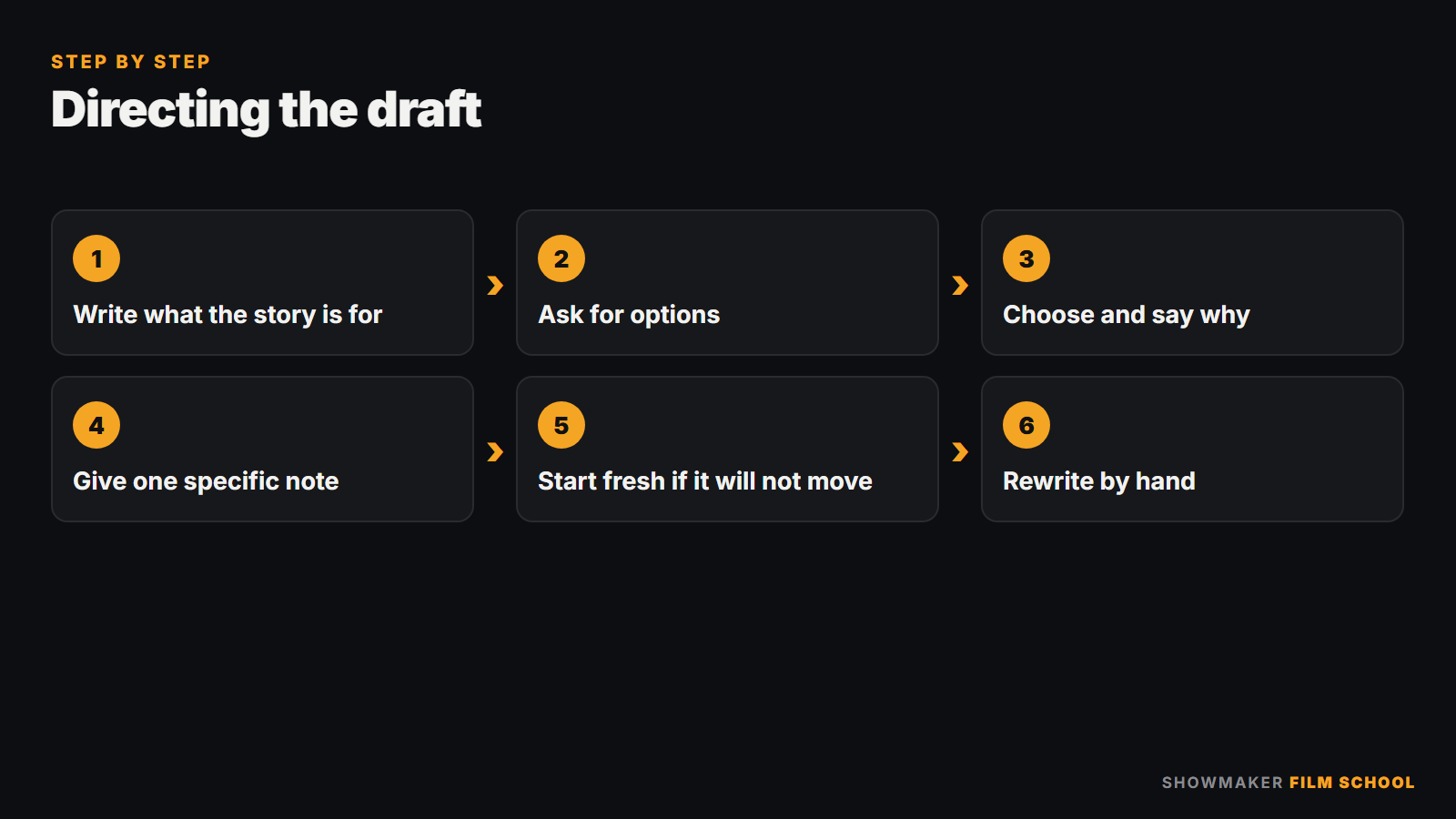
Use AI as a writing partner you give notes to, asking for options and choosing between them, instead of accepting its first draft.
An AI writing tool will give you a complete, tidy draft in seconds, and that is exactly the danger. A first draft from a machine reads smoothly, so it is easy to accept. It is also usually the most average version of your idea: the expected twist, the expected names, every feeling said out loud. You are the writer. The tool is a partner who drafts fast and never gets tired, and it needs a director.
Directing an AI writing partner means you decide, every round.
Directing it starts before you ask for anything. Write down what the story is for: who is watching, what feeling they came for, what the lead must never do. For our telenovela La Abuela, the director's statement was that the grandmother holds the family together with love and ruthlessness, but clean hands. That one sentence ruled out dozens of drafts at a glance: any scene where she picks up a weapon herself was wrong, however well written.
Then ask for options, not answers. Three premises, five openings, four ways the midpoint could go. Read them as a producer reads pitches. Most will be flat. One will have a detail worth keeping, and often the best idea is a piece of one option joined to a piece of another. You choose, and you say why.
Notes to the tool work the way notes to a human writer do. "Make it better" gets you the same draft with bigger words. A specific note gets a real change: "She is never in danger; give the villain a win at the midpoint that costs her someone she loves." When a tool keeps returning to its last draft no matter what you say, start fresh with your notes written into the request instead of asking it to revise again.
Do the thinking first. Before our team asked for a new long-form premise, the director asked for an analysis of what the heroines of the most-watched dramas actually do and why it works for their audience. Only then did we draft. Analysis first, then ideas, keeps you from asking a fast machine for the wrong thing.
Next in the app: the steps in ShowMaker, the exercise and a 3-question quiz.
Turn a loose idea into a one-sentence premise with a person, a want, a problem and a secret.
An idea is a situation: a grandmother who finds a lost granddaughter, a nurse who recognises a patient. A premise is a story you can test. It names a person, what she wants, what stands in the way, and why we cannot look away. If you cannot say it in one sentence, the story is not ready to write.
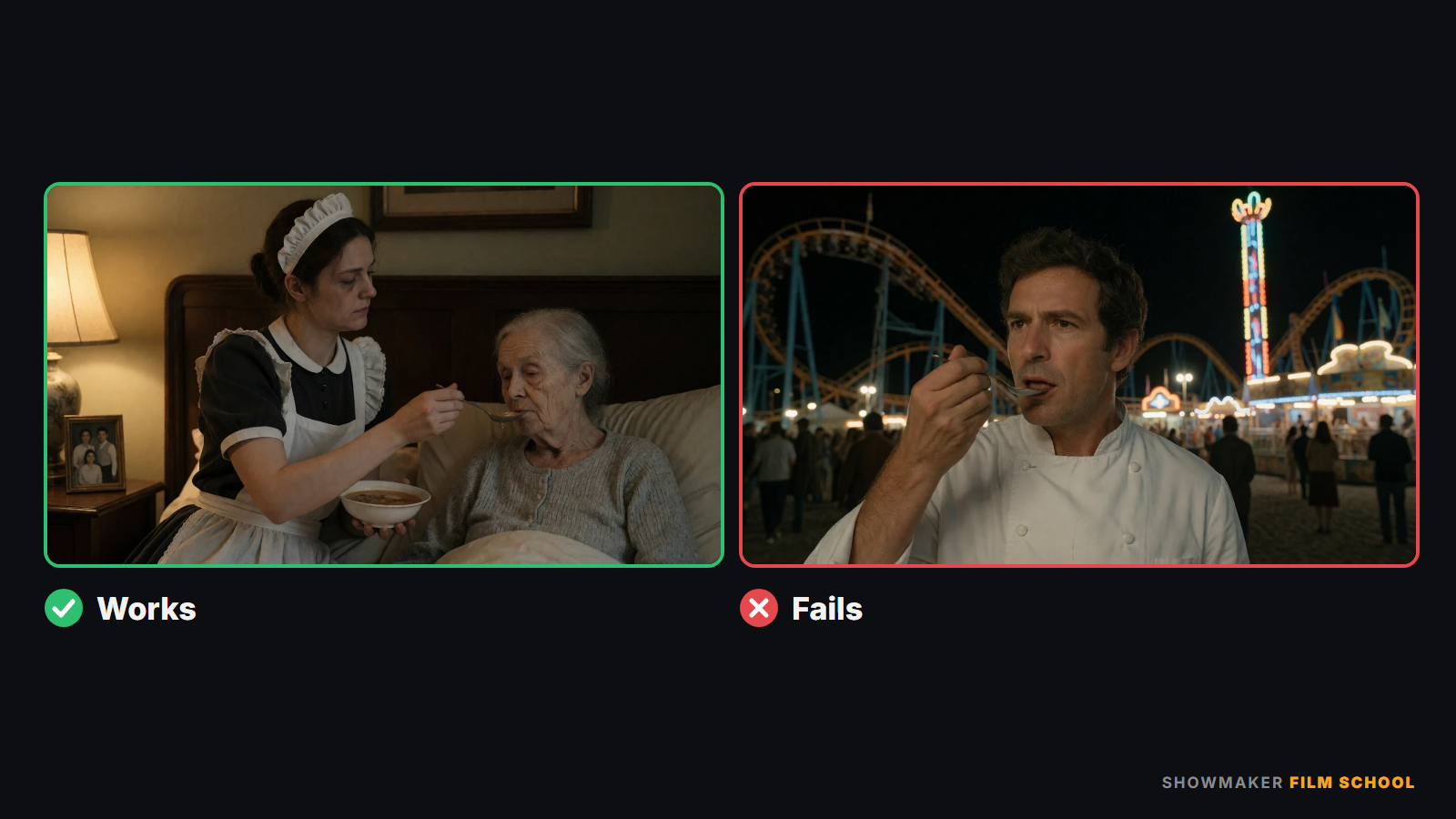
A premise you can feel at once, beside one that must be learned first.
A useful shape is: when someone ordinary is pushed into a problem, she must want something badly while someone close stands in her way. Add the secret the audience will know before she does. "A family's maid, mocked at their dinner table for years, cares for the old grandmother no one else visits, not knowing the will names her as the heir." You can see the person, the humiliation, the want, the enemies and the secret in one line.
Keep the setting ordinary and put the invention into the situation. The places viewers know from their own lives, a kitchen, a dinner table, a hospital corridor, need no explaining, so the feeling arrives at once. A strange world has to be learned first. One premise we threw out was set in a seaside amusement park run by a man with a super sense of taste. Every part of it was clever and none of it was felt.
Test the premise before you write a page. Say it to someone and watch their face. Ask them who they are rooting for and who they want to see punished. If they cannot answer, the want or the villain is not clear yet. Then write it as the title the audience would click: what was done to me, then the turn. If the title is dull, the premise usually is too.
Write three premises for every one you keep. The first idea is often the one everybody else had too.
Next in the app: the steps in ShowMaker, the exercise and a 3-question quiz.
Give each main character a want, a wound and a code, so their choices drive the story.
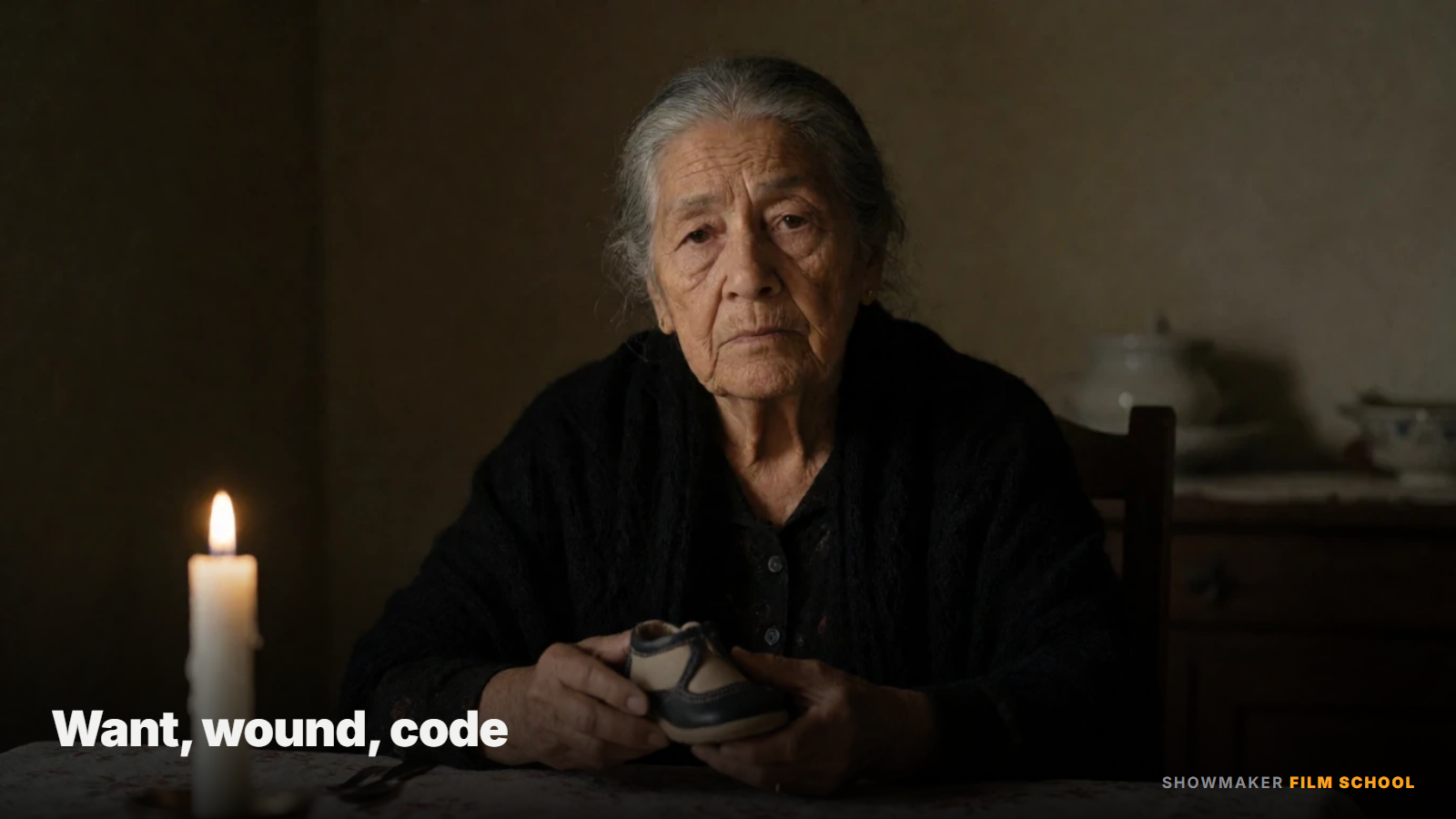
A character the audience follows for an hour is built from three things. The want is what she is trying to get, and it should be something we can see: get her grandson back, be named in the will, keep the house. The wound is the hurt underneath, almost always about love: a mother who chose her brother, a husband who left, a family that treated her as staff. The code is what she will and will not do to get the want.
A lead the audience follows has a want we can see and a wound underneath it.
The want gives every scene a direction. The wound explains why she wants it so badly, and why some insults land harder than others. The code is where drama comes from, because the story keeps pushing her toward the line she said she would never cross. In La Abuela, the grandmother's code is clean hands: she never holds a weapon, never handles the money or the evidence herself, never lies before God. The film's tension is how far she can go and still keep that code.
Make the virtue ordinary and prove it with a sacrifice before you reward it. The heroines audiences love most are not secretly brilliant at something rare. They are kind when no one is watching, they remember, they care for someone others ignore, and the story makes them pay for it first.
Villains need the same work. Give the antagonist a want too, one that makes sense from inside: the son who sold the grandson needed the money, or believed the boy was better off. A villain who is only cruel is easy to write and easy to forget. Keep them close to the lead, at the same table, because a betrayal by family hurts more than one by a stranger.
Write a short card for each main character before you write scenes: name, age, want, wound, code, and one thing they would never say out loud. When a scene feels flat later, the card usually tells you why: nobody in it wants anything.
Next in the app: the steps in ShowMaker, the exercise and a 3-question quiz.
Write each character so they sound like nobody else, then cast a voice that matches their age, accent and place.
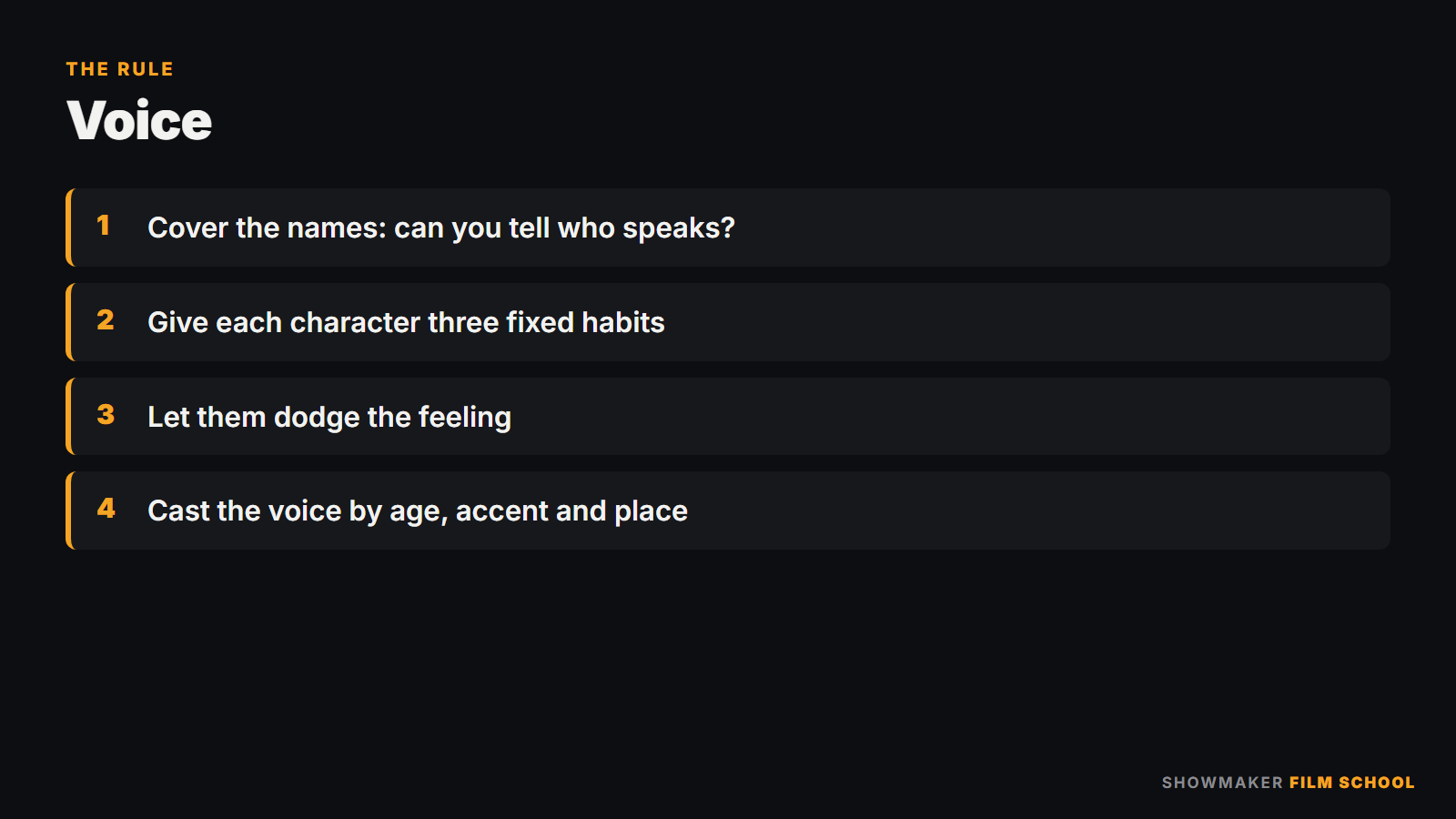
Cover the names in your script and read the dialogue. Can you tell who is talking? If every character speaks in the same full, polite sentences, they cannot be told apart, and that is one of the clearest signs of AI-written dialogue. Real people differ in how much they say, the words they choose, what they avoid, and how they address the person in front of them.
Different people speak differently. Write it, then cast it.
Give each character a few fixed habits. The grandmother speaks in short commands and proverbs and never raises her voice. The son talks too much when he is lying. The maid answers in as few words as possible and always says usted. A teenager cuts sentences off. Habits like these are cheap to write and do most of the work of telling characters apart. Write them on the character's card and keep them all film long.
Let characters avoid the obvious. A mother does not say "I am hurt that you lied to me." She asks if he has eaten. The line that dodges the feeling makes the viewer feel it. Each time a character names an emotion directly, try a line where they talk about something else instead.
Then cast the voice the way you would cast an actor. The voice has to fit the age, the place and the class you wrote. A Mexican grandmother needs a Mexican Spanish voice of the right age, not a young voice or a voice from another country. Listen to each candidate saying one of your real lines, because a voice's label can be wrong and its accent lives in how it actually sounds. If no ready voice fits, especially for children or a particular accent, design one from a description.
Voice the lines before you plan the pictures. The voiced take sets the timing of the shot, and hearing a line out loud is the fastest test of whether it sounds like a person.
Next in the app: the steps in ShowMaker, the exercise and a 3-question quiz.
Break your story into scenes by place and time, so every scene has one room and one moment.
In a screenplay, a scene is one place at one time. When the characters walk from the kitchen into the hallway, that is a new scene, even if the argument carries on and the house is the same. A different room is a different location. When the story jumps to that night or the next morning, that is a new scene too. Each scene begins with a heading that says inside or outside, where, and when.
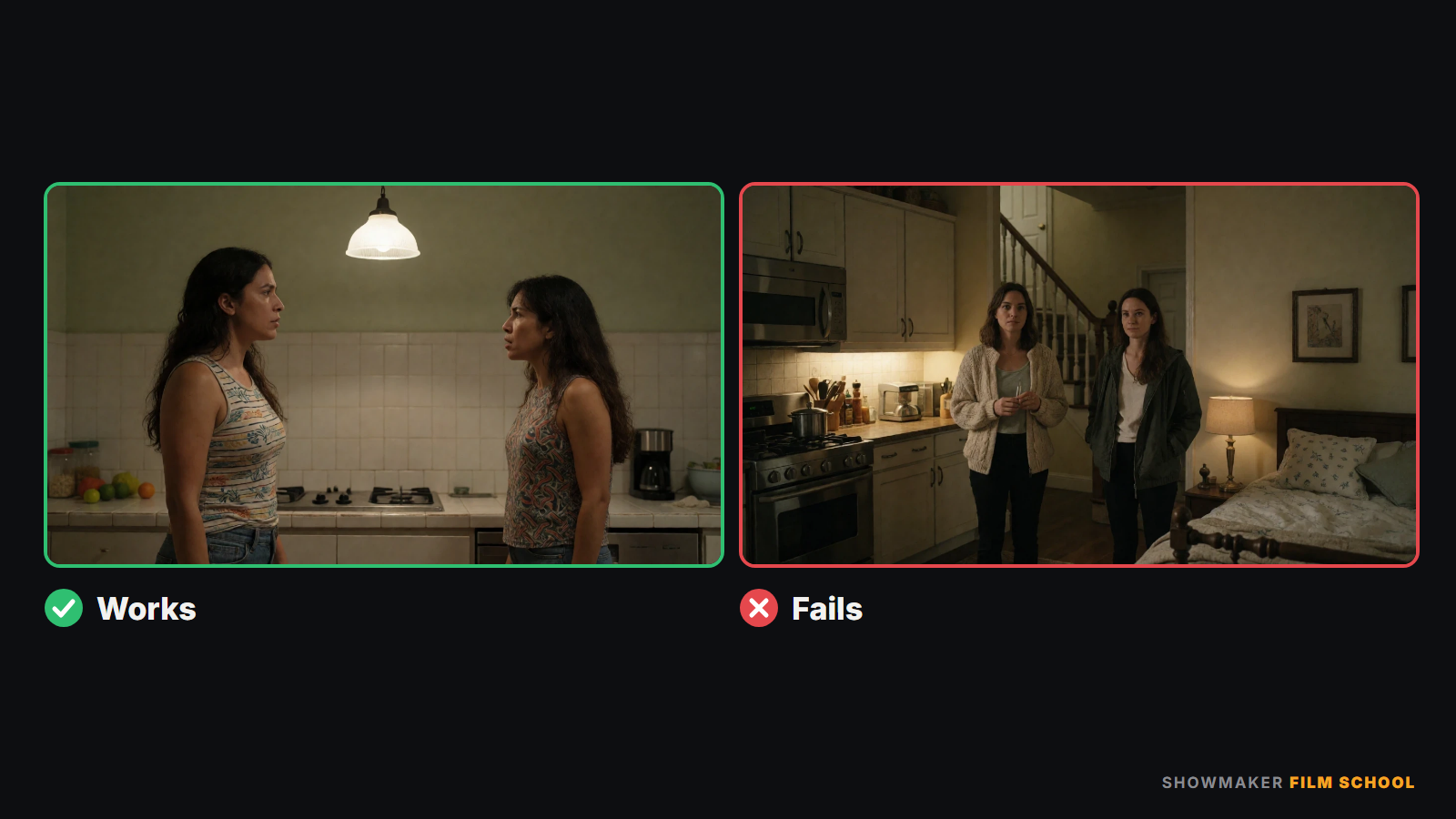
One scene, one room. Left: a scene that stays put. Right: a scene that wanders through the house.
Writers who come from novels often break scenes by feeling instead, starting a new scene when the mood turns. That leaves scenes that wander through three rooms, or several scenes that share one heading. On a film set it is a scheduling problem. With AI it is worse, because the tools read the heading to decide what room to draw. A scene headed "the house" that really happens in the kitchen, the stairs and a bedroom will come back as one vague room, or as a different room in every shot.
So when you outline, think in places. A wedding becomes the church, then the reception hall, then the parking lot where the real fight happens, three scenes. A long phone call between two people in two homes is two locations; decide whether you cut between them or stay on one side.
Keep each scene to what can happen in that place at that time. If the grandmother needs to read the letter in her bedroom and then confront her son at dinner, those are two scenes, and the cut between them is a chance to skip time and let the viewer feel her deciding. Cutting between scenes is free storytelling; a scene that drags across rooms is not.
Name each location the same way every time it appears. If the dining room is "the dining room" in one heading and "the big room" in another, both a reader and the tools may treat them as two places.
Next in the app: the steps in ShowMaker, the exercise and a 3-question quiz.
Write action as things a camera can see, cut held stares and explaining lines, and audit the screenplay.
Everything in a screenplay's action lines has to be something a camera can see or a microphone can hear. "She realises he has been lying all along" cannot be filmed. "She turns his phone over. A message from the bank. She puts it back face down, exactly where it was" can. The second version also lets the viewer realise it with her, which is more exciting than being told.
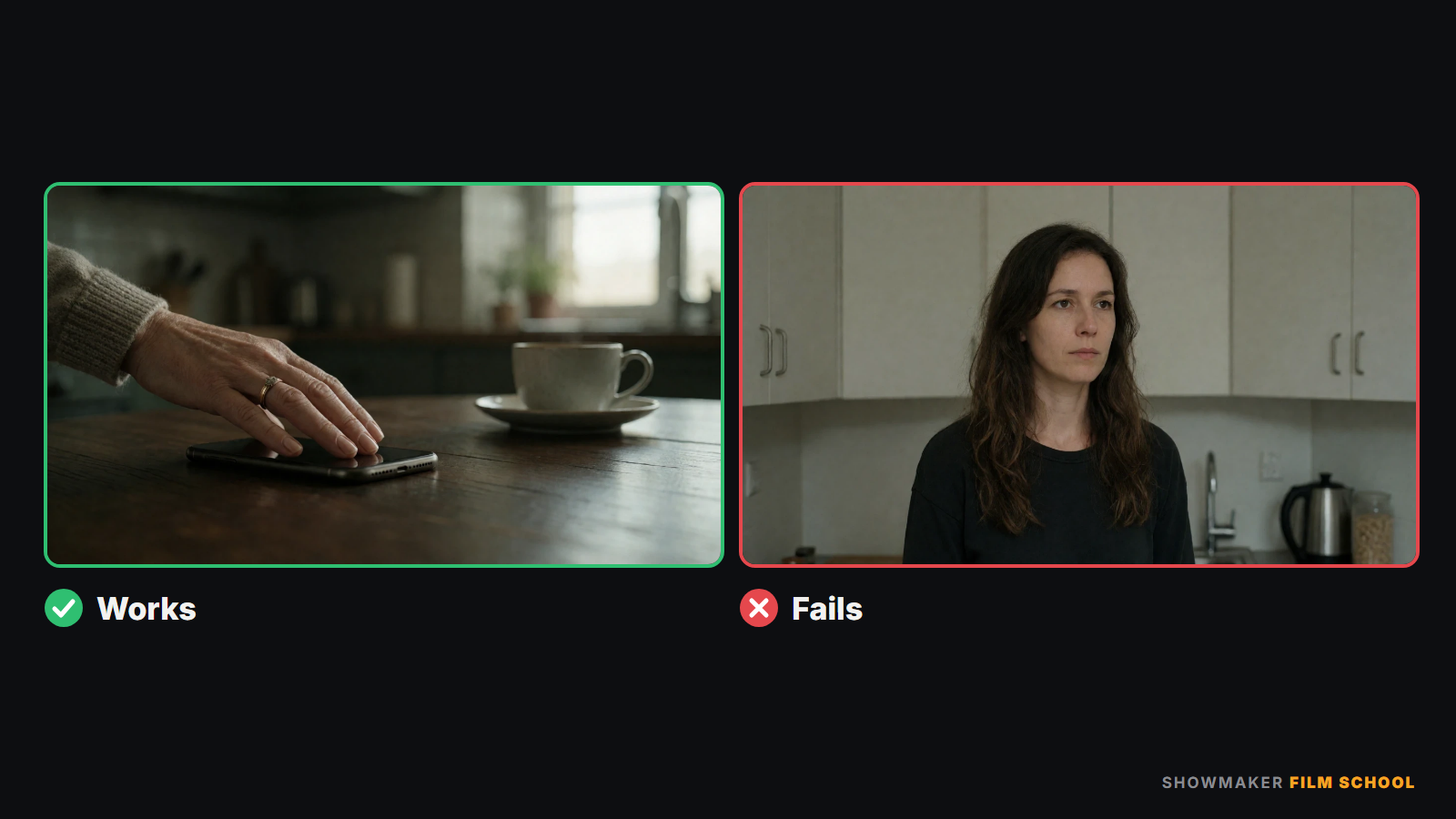
Write what the camera can see. Left: a filmable action. Right: a stare the model cannot play.
Turn every thought into a visible action or a line. A worry becomes a hand checking a pocket. A decision becomes a coat taken off the hook. Love becomes a plate saved and kept warm. If you find a feeling in your action lines, ask what someone in the room would actually see.
Cut held stares and long silent pauses. Screenwriters love "She holds his gaze for a long beat." AI video models cannot play a held stare on cue; the beat comes back as dead air or as a face that slowly drifts. Pace a scene with cuts, lines and a button instead. If the moment needs weight, cut to a close-up of something that matters, such as the hand, the ring or the letter.
Dialogue should cut too. Most lines can lose their first and last few words. Characters should not explain the plan or the theme to each other for the audience's sake. In a draft of La Abuela, a line told the viewer exactly why nine days was the perfect amount of time. The director cut it, and kept the proverbs that close scenes, because in a telenovela a proverb is the genre's voice and an explanation is not.
Write one subject per beat where you can. "Elena reads the letter." Then "Rodrigo watches from the door." Two beats, two clear shots, instead of one crowded line that asks for both at once.
When a draft is done, audit it. Read it as a stranger, looking for anything a camera cannot see, any stare, any line that explains. A second reader, human or tool, finds what the writer has stopped noticing.
Next in the app: the steps in ShowMaker, the exercise and a 3-question quiz.
Find the marks of a flat AI draft and rewrite it with subtext, conflict and cost.
A flat AI draft is easy to spot once you know the signs. Everyone is articulate and says exactly what they feel. Scenes end tidily. Every plan works the first time. The same comfortable phrase turns up again and again. When our team read a full long draft through in one sitting, one small phrase, an offer of a little coffee, appeared in eight of its nine set pieces. Nobody noticed it scene by scene. Read whole, it sounded like a machine.
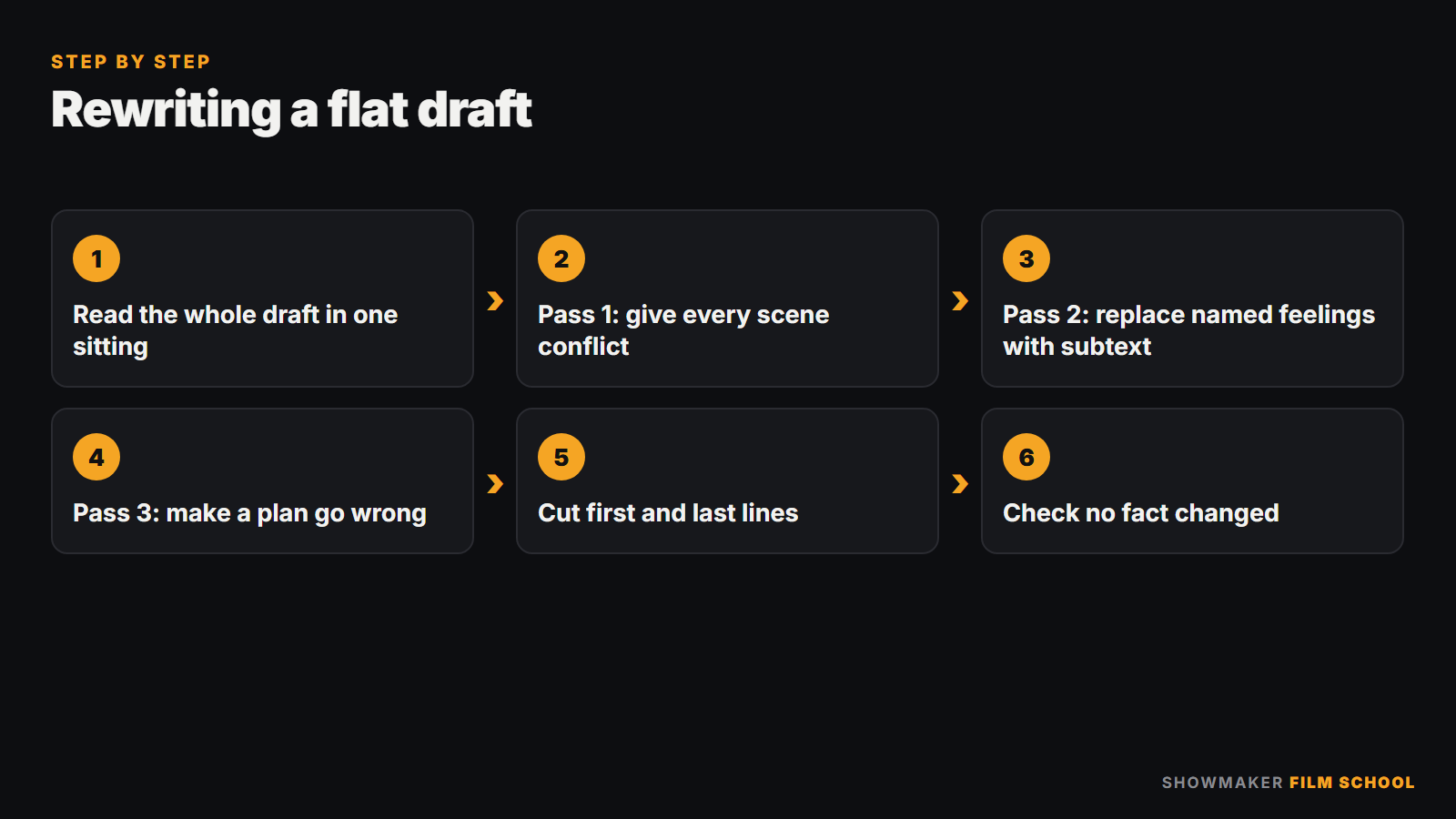
A flat draft is fixed in passes, one problem at a time.
Rewrite in passes, one problem at a time. First pass, conflict: every scene needs two people who want different things. If they agree, cut the scene or give one of them a reason to push back. Second pass, subtext: find every line where someone names a feeling and replace it with what they would really say instead. Third pass, cost: find every plan that works and make something go wrong. A door opens early. A witness says the wrong name.
Then cut. Most flat drafts are too long because they explain. Take out the first line of each scene if the scene can start without it, and the last line if the button already landed. La Abuela came back from its first full draft with 49 scenes, and the director cut it by hand to a lean film, scene by scene, keeping every turn and dropping every line that told the viewer what to think.
When you hand a scene back to the AI for a rewrite, give it a note it can act on, and tell it what must not change. "Keep the proverb at the end. Cut the line where she explains the money. Make her son refuse at first." Then read every change it made, because a rewrite tool can quietly change a fact, such as who is whose son.
The finished scene should feel shorter than it is. If you are bored reading it, a viewer will be bored watching it.
Next in the app: the steps in ShowMaker, the exercise and a 3-question quiz.
Write an opening that hooks in the first seconds, rate it, and improve it in rounds without chasing the score.
A viewer decides in the first seconds whether to stay. In a feed of short videos it is even faster. The hook is the opening that makes leaving feel like a loss. It does three things quickly: it shows a person we care about, it puts something at stake, and it opens a question that only the rest of the film can answer.
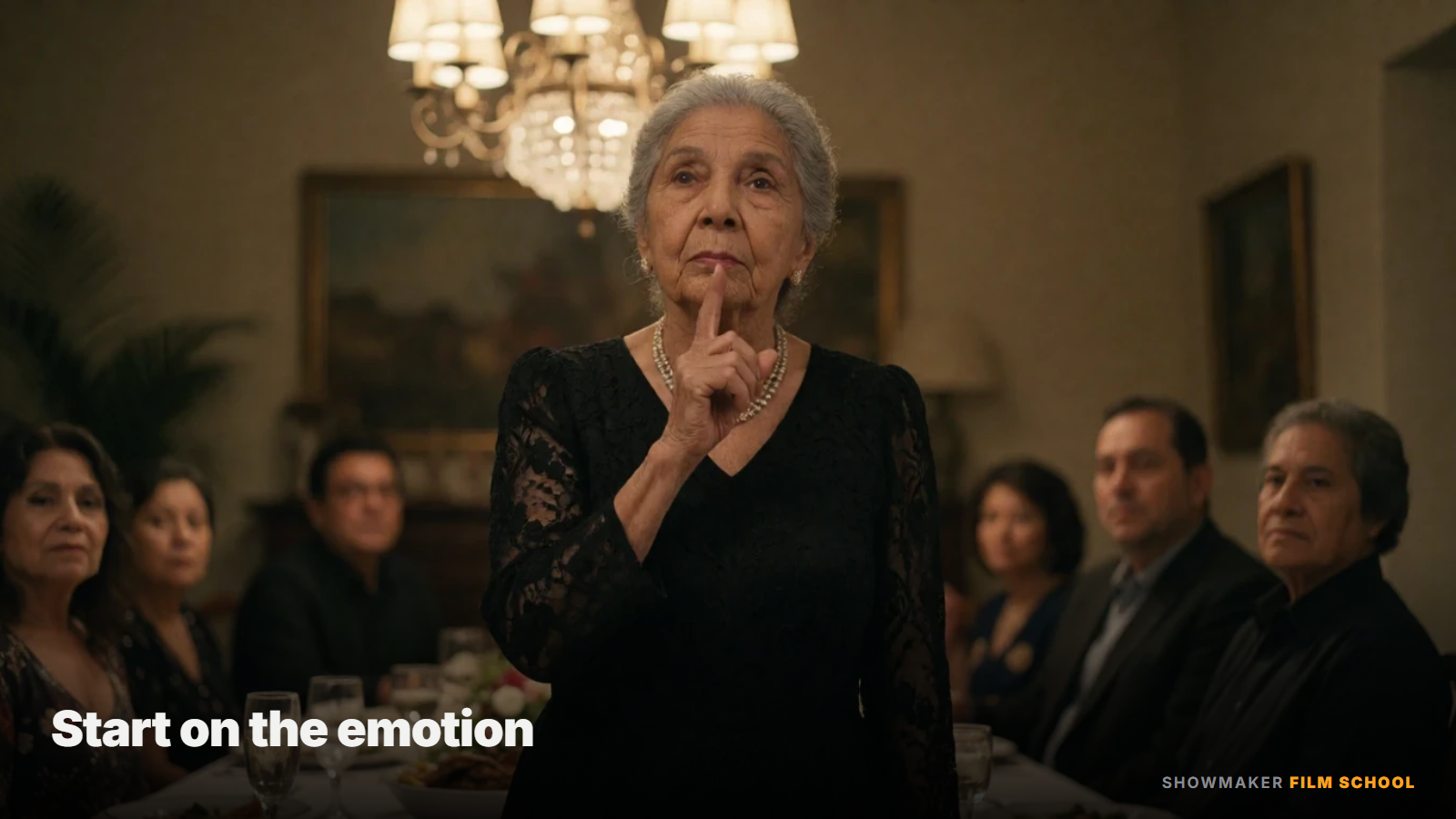
Open on the emotion. Guadalajara starts on a grandmother's announcement, not on a drive up to the house.
Start on the emotion, not the setup. Our Guadalajara telenovela opens on Doña Elena announcing that she has found her granddaughter. No arrival, no establishing drive up to the house, no introductions. The family's reaction to that one sentence tells the viewer who will fight and why. When we looked at who watched, most of our audience were older women, and the grandmother's emotion was what held them, so we give her an emotional beat in every episode and open on one where we can.
Write the first line last. Once you know the whole story, go back and find the line that carries the most of it in the fewest words, and open on that. Cut anything before it.
A rating is a tool for finding the weak spot, not a grade to chase. ShowMaker's Writers' Room scores a draft on a few measures and gives notes. Read the notes first, because the number only tells you something is wrong. A test show of ours went from scores of 7, 5 and 6 to 8, 7 and 8 over three rounds of improving. Give each round one specific note to answer, such as a clearer secret or a sharper first line. A round that only tries to push the number up tends to change the words and leave the story where it was.
Stop when the hook does its three jobs. A hook that scores a little lower but sounds like your story beats one rewritten into somebody else's.
Next in the app: the steps in ShowMaker, the exercise and a 3-question quiz.
Turn a finished scene into a storyboard where every shot carries its lines word for word.
A storyboard is the script turned into pictures, shot by shot. It is where you find out whether your scene can be filmed the way you wrote it, before anything expensive happens. If you wrote clean, filmable action with one subject per beat, the storyboard nearly draws itself. If you wrote stares and feelings, this is where you find out.
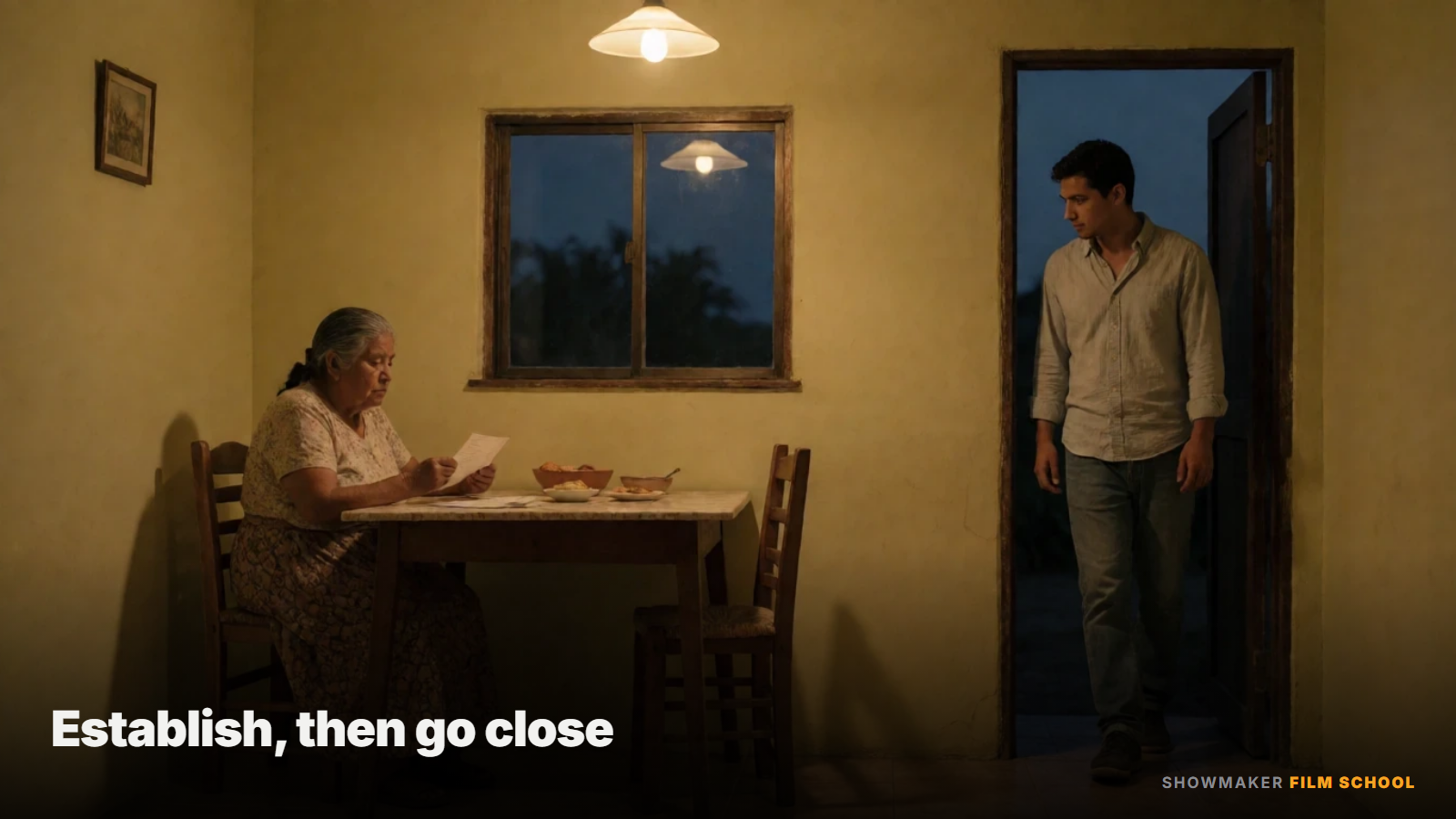
Open each scene on one wide that shows where everyone is, then go close.
Go through the scene beat by beat and give each one a shot. Open on one establishing wide that shows where everyone is. After that, use mediums, close-ups and over-the-shoulders, each with one subject where you can. The person speaking a line is in the shot that carries it, and the lines stay word for word, in order, with the right speaker. A storyboard that rewrites your dialogue is a different script.
Choose shot sizes for meaning. A wide tells the viewer where they are. A medium shows what a person is doing. A close-up shows what they feel, and it is where the important lines go. An insert, a close shot of an object, a ring or a letter or a phone screen, tells the viewer what matters. A scene that is all wides keeps the audience at a distance; a scene that is all close-ups loses them in the room.
Read each drawn frame against the script, not just against itself. Is the right person in it? Are they where the wide put them? Is anyone there who should not be? Fix the frame now. Changing a picture is cheap; changing a rendered video shot is not.
Our La Abuela opening scene is three panels and eight lines, about 50 seconds. That density, every shot doing a job and no shot repeating another, is a good target for your first storyboard. If your scene needs twice as many shots to tell the same amount of story, look for shots that repeat each other and cut one.
Next in the app: the steps in ShowMaker, the exercise and a 3-question quiz.
Build a 30 to 60 second teaser from moments already in your script and storyboard it.
A teaser sells the film using the film. It is made from moments that are really in your script, so a viewer who clicks gets the story they were promised. Inventing a scene for the teaser that the film does not contain is the fastest way to lose the audience's trust in the first minute of the real thing.
A teaser sells the film using the film's own moments.
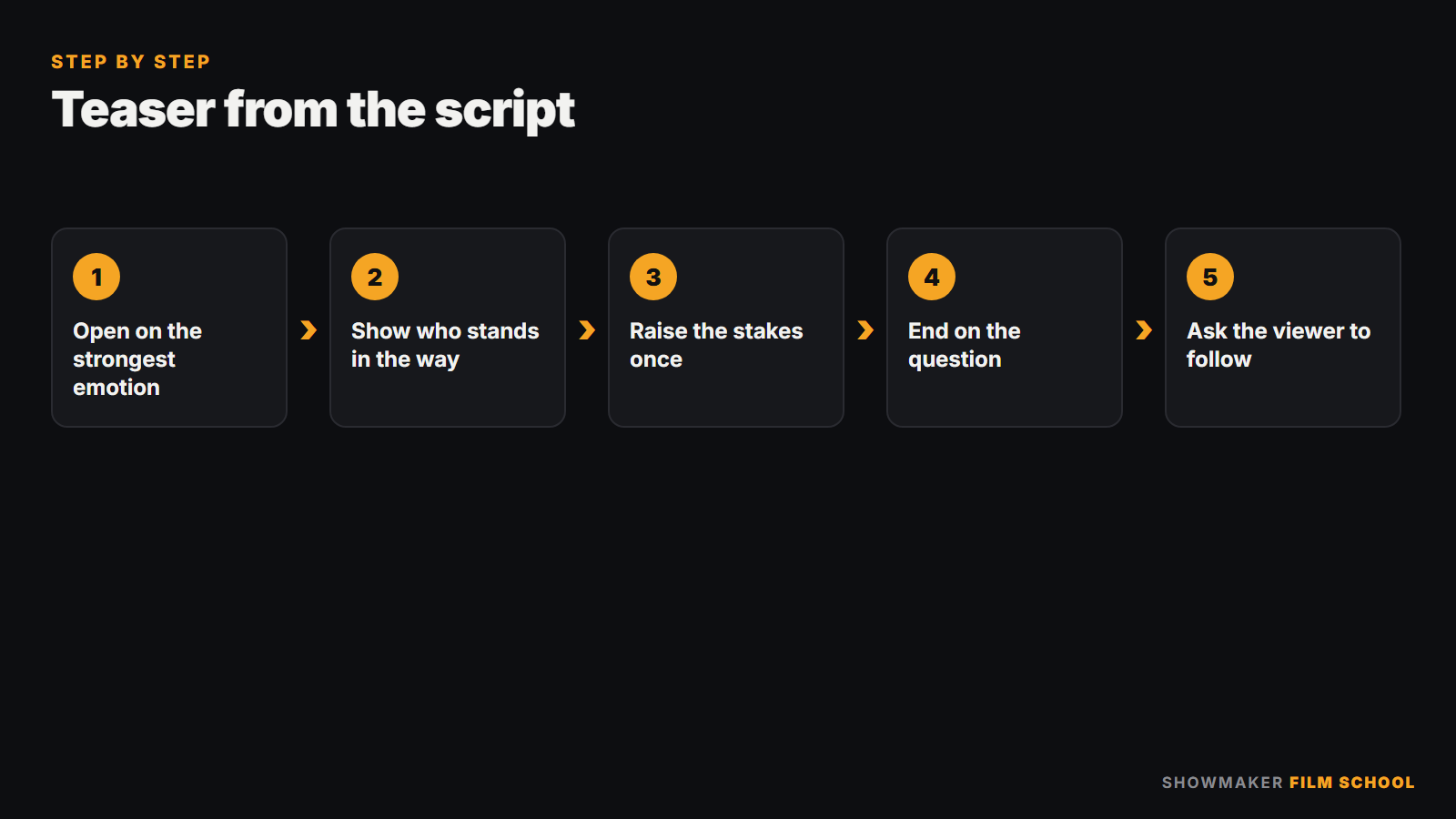
Pick four to six moments. Open on the strongest emotion in the script, a face at the moment the secret lands, or a line that makes the viewer lean in. Then show who stands in the way. Then raise the stakes with one moment of danger, a slap stopped, a door slammed, a threat. End on the question, not the answer: the letter about to be opened, the name about to be said. Never show the reveal.
Use the script's own lines, word for word. A teaser line works best when it is short and makes sense on its own without the scene around it. Doña Elena's line from the opening of Guadalajara, "Lo que voy a decir cambia esta casa para siempre" (what I am about to say changes this house forever), works out of context. A line that needs the setup does not.
Keep it short, 30 to 60 seconds. Each moment gets a few seconds, enough to land and no more. End with a clear ask: follow the channel, watch the full film. A teaser that does not tell the viewer what to do next leaves them with nowhere to go.
Because it is built from the script, the teaser also tests your script. If you cannot find four strong moments in your own pages, the script needs more of them before you film anything. Go back to the scenes around your midpoint and your lowest point; that is usually where the strongest moments should be, and where a flat draft is thinnest.
Next in the app: the steps in ShowMaker, the exercise and a 3-question quiz.