Plan, cast, shoot and release a vertical drama series built to be binged on a phone. You finish with Episode 1 in the Film School Showcase and a hook Short that sends viewers to it.
The lessons are free to read, and you can sign up free to take a course. To finish your film you need a paid ShowMaker plan: video rendering uses credits, and credits are not free. Writing, casting, pictures and voices can be started on the free plan, within its limits.
Lesson 1 · 10 min · Free plan, within its limits
The hook in 60 seconds
Write a one-minute opening that makes a stranger stop scrolling, then rate it and make it better.
A micro-drama is watched on a phone by someone whose thumb is already moving. You do not get a slow opening. The first ten seconds have to show something happen to a person that the viewer understands at once and feels in the stomach. That is the hook, and the rest of the series is the long answer to it.
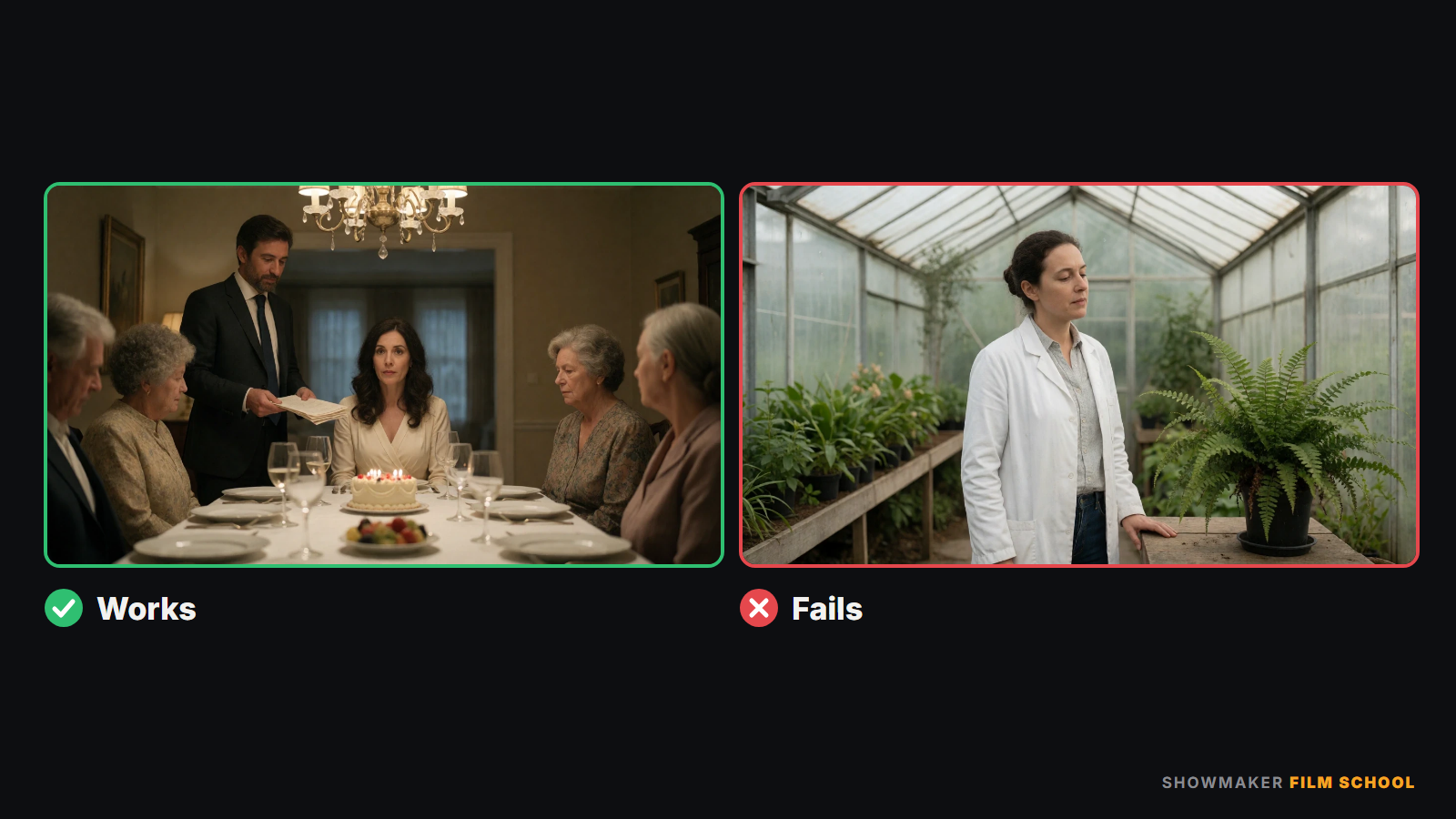
The strongest hooks are ordinary. A wife is handed divorce papers at her own birthday dinner. A maid is accused of theft in front of the guests she just served. A son is told at the wedding that his mother was never invited. Viewers know these rooms: the kitchen, the dinner table, the office, the church. Quirky setups, like a woman who talks to plants or a talking cat lawyer, read as weird and get swiped away, because the viewer has to work out the rules before they can feel anything.
An ordinary room and a public humiliation stop the thumb. A quirky premise asks the viewer to learn rules first.
A good hook has three parts. First, a humiliation done in public, so there are witnesses. Second, a hint of a secret: the person being shamed knows something, owns something, or is someone the others do not suspect. Third, a last line or image that leaves a question the viewer needs answered. The title names the hook too, in the form of what was done to her and what she is hiding.
Our telenovela set in Guadalajara opens on the family at the table, and the matriarch's first line is "Silencio. Lo que voy a decir cambia esta casa para siempre." ("Silence. What I am about to say changes this house forever.") It names a promise in eight words and makes the table the stage. Everyone at that table is now a witness.
Judge your draft on three things. Quality: do people talk the way people talk, and does each line push someone? Shock: does one moment land that the viewer did not see coming? Series: does the end leave a question big enough to need Episode 2? A first draft from an AI writer usually scores fine on quality and low on shock, because it softens the cruel moment. Your job is to put the cruelty back. Read the notes, choose the ones you agree with, rewrite, and rate again. Stop when the shock is real and the last line asks a question. Chasing a higher number past that point mostly makes the scene louder.
Next in the app: the steps in ShowMaker, the exercise and a 3-question quiz.
Tropes that carry a season, and a cliffhanger every episode
Stack two or three tropes into a season outline where every episode climbs and ends on a question.
A trope is a story shape the audience already knows how to enjoy. Revenge on the people who shamed you. A hidden identity, like the poor girl who is really the heir. A contract marriage that turns real. A powerful man in disguise. In film school you may have been told tropes are lazy. In micro-drama they are the genre. Viewers choose a show because they know the pleasure it promises, and they stay because you deliver it harder than they expected. Play the tropes straight and with full feeling; a wink at the audience kills the drama.
One trope makes a scene. Two or three stacked together make a season. Revenge plus hidden identity gives you a lead who is humiliated, who secretly has power, and who chooses when to reveal it. Each reveal is an episode. Add a contract marriage and every revenge step now costs her something with the man she is falling for.
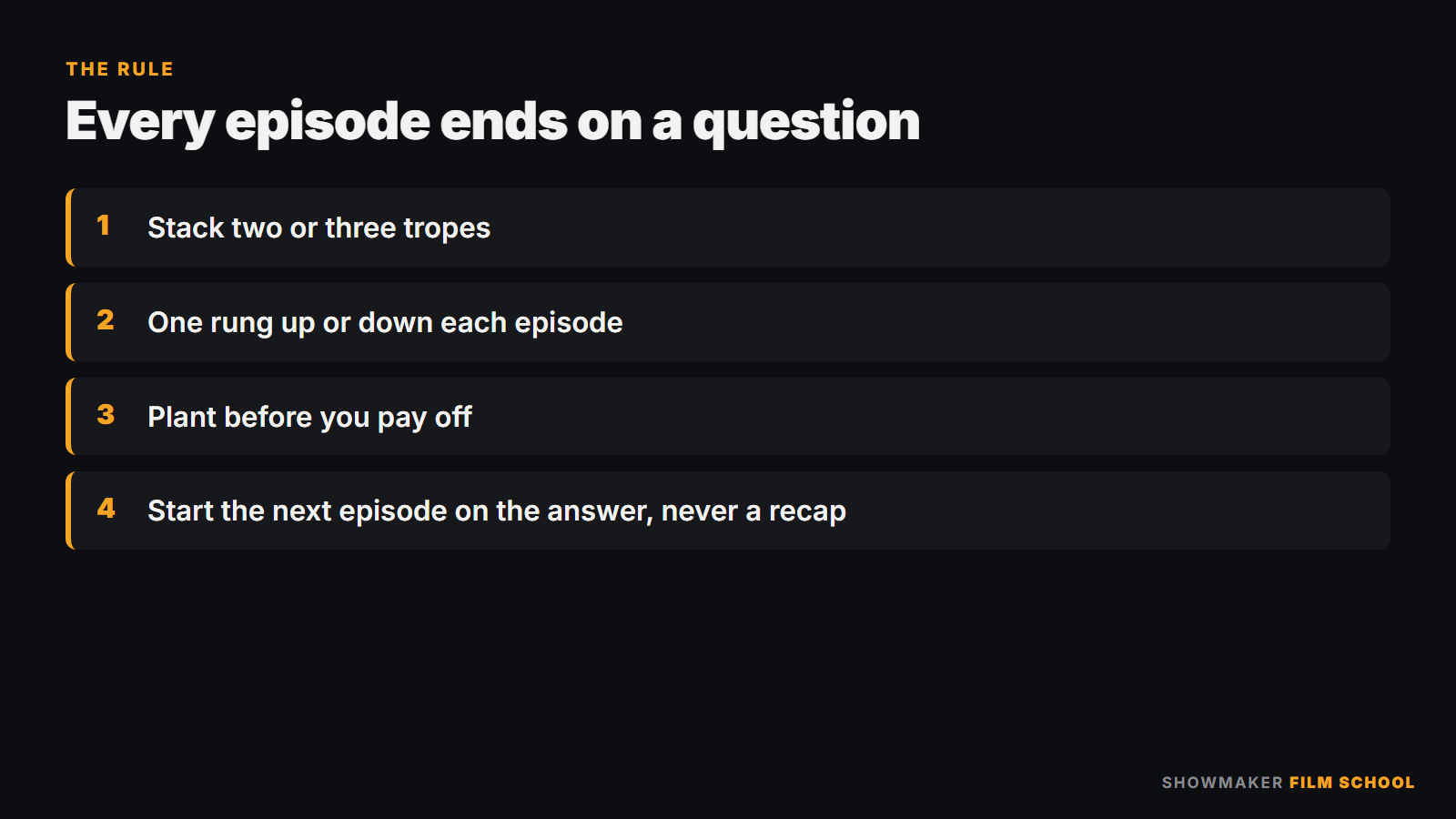
A season is a ladder. Each episode moves the lead one rung and ends before the answer.
Plan the season as a ladder. In each episode the lead climbs one rung or falls one: she gets a job inside his company, she is caught, she finds the document, her sister betrays her. Plant every payoff before you pay it off. If the will is read in Episode 8, the viewer must see the locked drawer in Episode 2. A payoff with no plant feels like a cheat, and a plant with no payoff feels like a mistake.
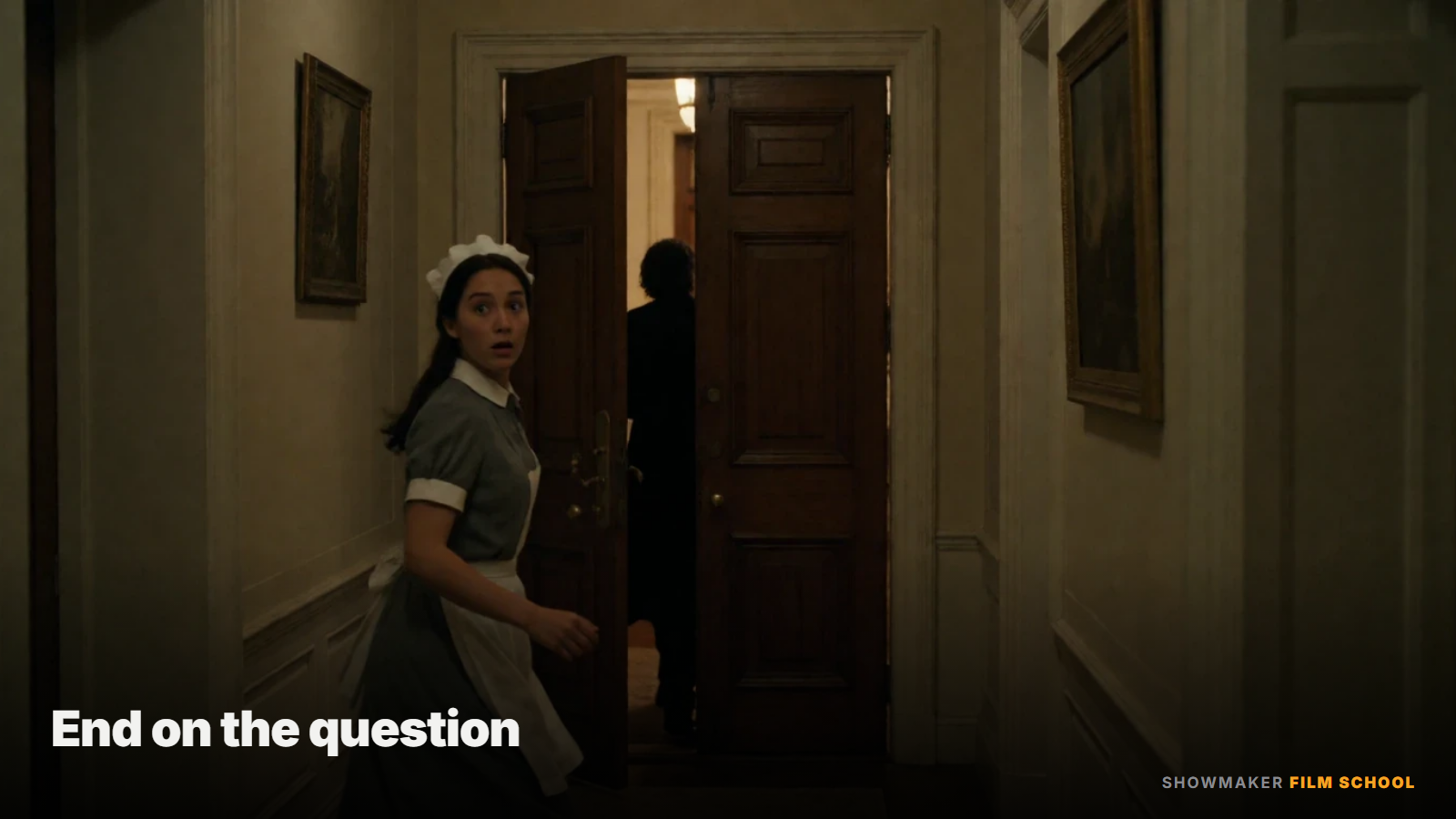
Every episode ends on a question. A door opens and we do not see who is there. A line is said that changes everything: "He is not your father." A choice is offered and the episode cuts before she answers. The next episode starts on the answer, never with a recap. Viewers who binge will hear your recap ten times and swipe away.
Here is a worked example for a nine-episode season built on revenge and hidden identity. Episode 1: the maid is accused of theft at the engagement party and fired. Cliffhanger: she opens an envelope with the family seal, addressed to her. Episode 2: the letter says she is the late owner's daughter. Cliffhanger: the fiance walks in and sees it. Each rung gives the next episode its first scene.
Keep the lead in real danger. A lead who is never at risk reads as competent and dull. Put a blow at the middle of the season that breaks her plan, and a lowest point where she must choose what to give up.
Next in the app: the steps in ShowMaker, the exercise and a 3-question quiz.
Write the reference that keeps your characters looking and acting the same in every episode.
A series bible is the book of things that do not change. A TV writers' room keeps one so that a writer joining in season two knows who everyone is, what they look like, what they want, and what can never happen. You need one for the same reason, plus one more: the picture model reads it. Every time a character is drawn, the model is told what to draw. If the bible is vague, the model fills the gaps with its own guesses, and its guesses change from shot to shot.
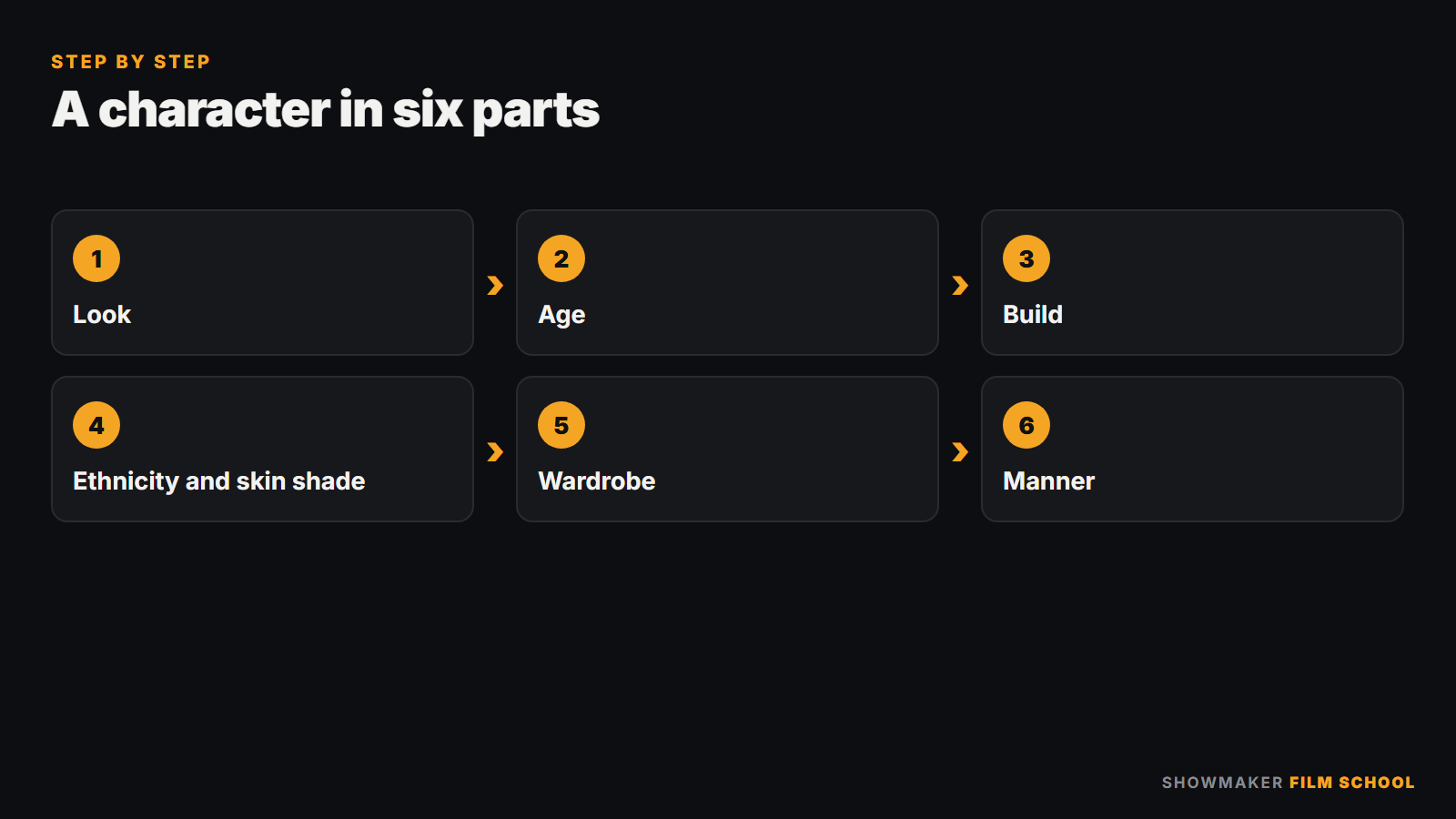
Describe each main character in six parts: look, age, build, ethnicity and skin shade, wardrobe, and manner. For example: Sofia Reyes, 27, slim and short, Mexican with warm light brown skin and long black hair worn in a low bun, a grey housekeeper's uniform with a white collar, keeps her eyes down and her hands folded until she is angry, then she looks straight at you.
Six parts for every character. The fourth is the one most often left out, and the model fills it with a default.
Never leave ethnicity or skin shade out. An unstated ethnicity is not neutral. The picture model has a default person it draws when you say nothing, and that default will not be your character. On one of our projects a whole cast came back looking European because the script named the people and never said what they looked like.
A bible can state a family's or a people's look once. "Every Reyes has dark brown eyes and a small scar-free face; the men wear silver rings" covers six characters. Then each character only needs what is different about them.
Write the world in a few lines: the city, the year, money and class, the rooms we return to. Then write the rules, the things that are always true. In a telenovela that might be: the matriarch's word is law at the table; nobody leaves dinner before she does; the house staff never speak to guests unless spoken to. Rules give your scenes friction, because a character who breaks one is making a choice the audience can see.
The bible is reference, never script. Nothing in it appears on screen unless a scene puts it there. Keep it short enough to read in five minutes. When something changes in the story, like a character who cuts her hair after Episode 4, write the change into the bible with the episode number.
Next in the app: the steps in ShowMaker, the exercise and a 3-question quiz.
Character sheets and outfits that hold from shot to shot
Draw each character once, check them, and give them an outfit for each story day so they never drift.
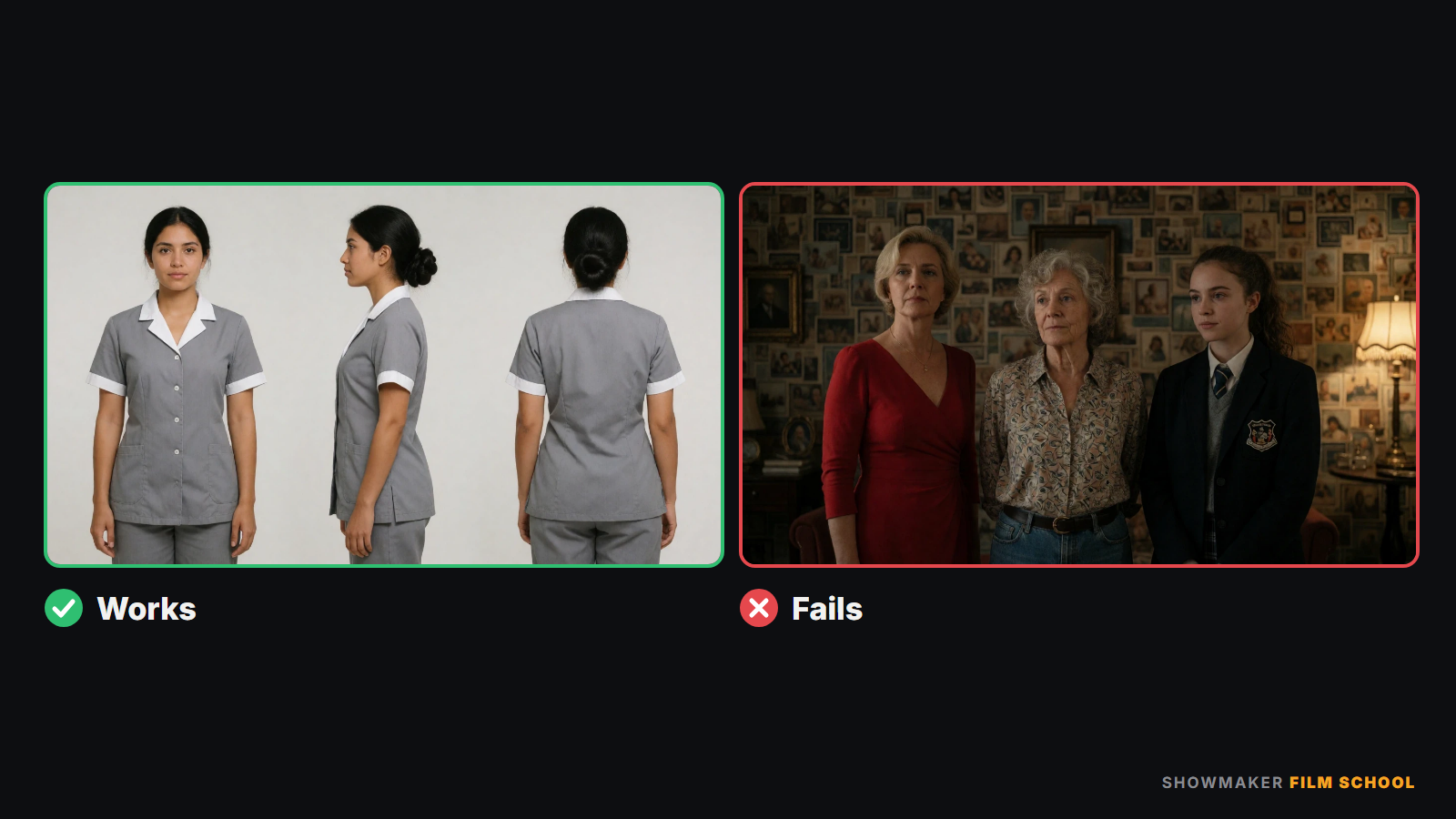
A video model draws every shot fresh. It does not remember that Sofia had a low bun in the last shot. It looks at the pictures it is sent and copies them. So the most important pictures in your series are not the beautiful shots; they are the plain reference pictures of each character, called sheets. A good sheet shows the person clearly, in even light, on a plain background, from more than one side.
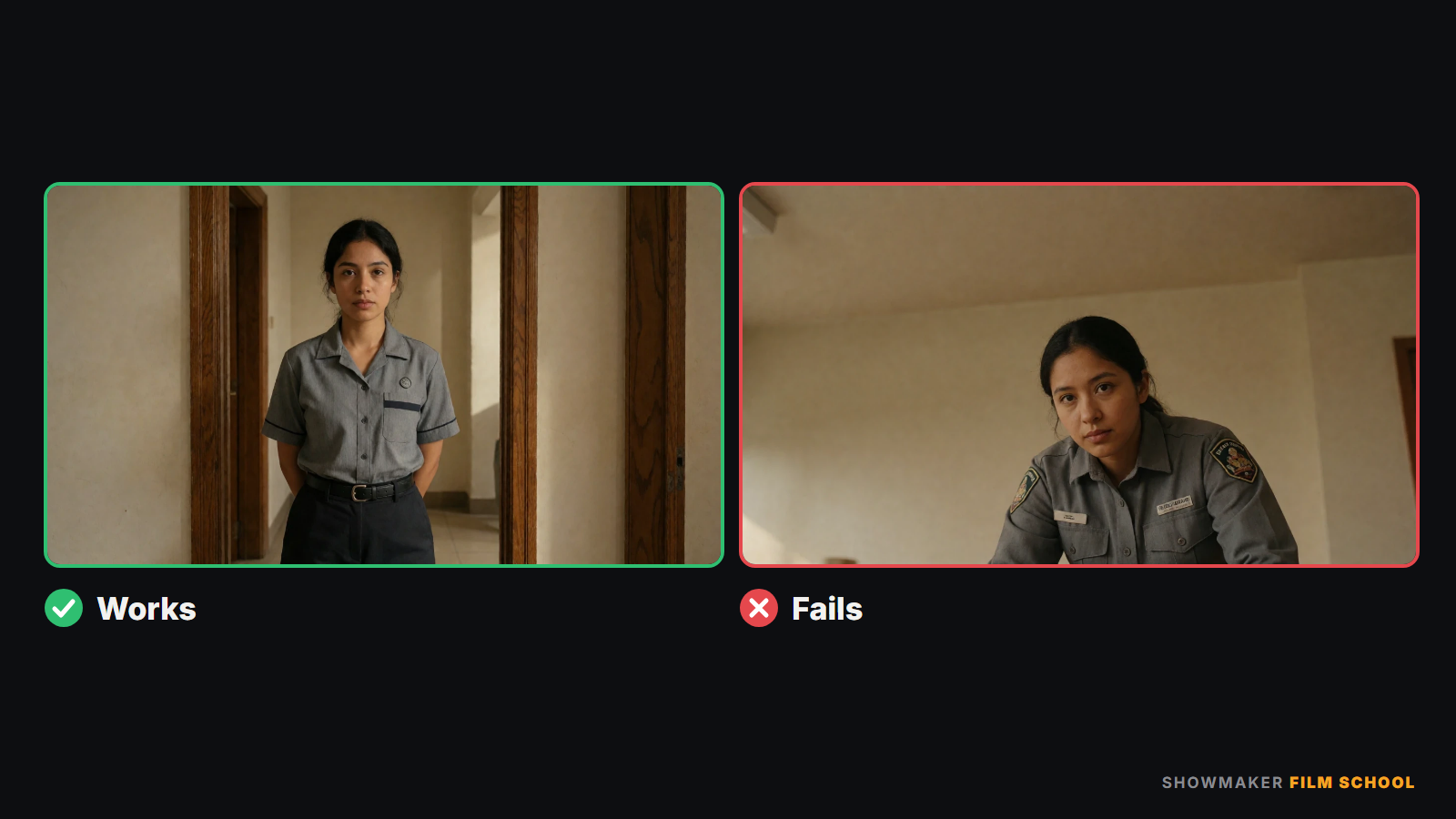
Draw the full-body picture first and check it hard before you build anything on it. Compare it with your bible line by line: age, build, skin shade, hair. On one of our shows a portrait came back younger and lighter-skinned than the writing, and if we had drawn the outfit sheets from it, the mistake would have been copied into every scene. A bad reference is worse than none, because it is confident.
One person, drawn the same from every side, is a reference the model can copy. Three different-looking people are not.
Outfits follow the story day. People change clothes between days and keep them on within a day. Before drawing wardrobe, list your Episode 1 scenes with the day and time of each: Day 1 morning, Day 1 night, Day 2 morning. Sofia wears her uniform all of Day 1, a black dress at the Day 1 night party, and the uniform again on Day 2. A uniform or a costume can repeat across days. A party dress worn the next morning is a story point, so only do it on purpose.
Each outfit gets its own sheet. If an outfit has no picture, the model invents one from the words, and the words drift. In one of our test series a nurse lost her uniform after the first panel because no outfit sheet had been drawn for it.
Keep each sheet simple: the person standing, arms relaxed, face visible, plain grey or white behind. Busy backgrounds leak into scenes. Props that belong to the outfit, like a name badge or a wedding ring, should be visible on the sheet too.
When a sheet is right, stop. Redrawing a good sheet to make it prettier changes the face, and a changed face in Episode 3 is a different actor to your audience.
Next in the app: the steps in ShowMaker, the exercise and a 3-question quiz.
Describe each room once, draw it empty, and reuse it so your series feels like a real house.
In a screenplay a scene is one place at one time. A different room in the same house is a different scene, and the same room at night is a different scene from the same room in the morning. This rule keeps your episode readable, and it also keeps your pictures steady, because each scene is drawn from one room picture.
A series lives in a few rooms that the audience comes to know: the dining room where the family fights, the kitchen where the staff whisper, the office where the deals are signed. Returning to the same room is part of the pleasure. It only works if the room looks the same each time.
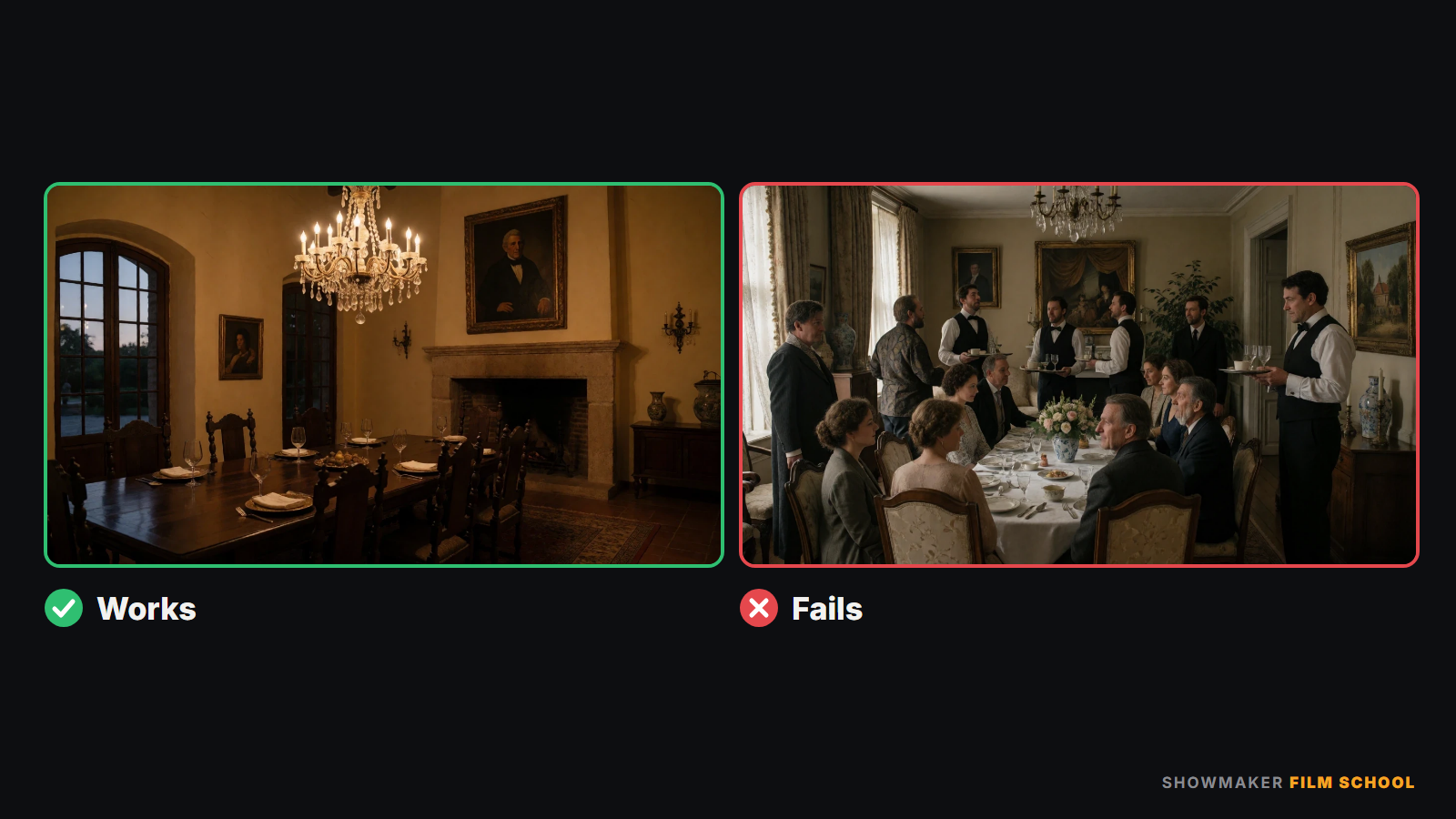
An empty room, laid for the people who will be there, is a set. A room full of people sends strangers into your shots.
Describe a room in layers so nothing is left for the model to guess. Start with the shape and size. Then the walls and floor. Then where the light comes from, such as tall windows on the left or a crystal chandelier over the table. Then the furniture and where it stands. Then the one feature the story uses, like the portrait of the late patriarch above the fireplace. Then the colors. Then the time of day.
That key feature must be in the words, and in the picture. If the portrait matters in Episode 5, write it into the room description now. A feature that is only in the picture can vanish when the room is redrawn at night.
Draw the room empty, with no people in it. People in a room picture get copied into your scenes as strangers. In our Guadalajara telenovela a wide shot of a long dinner table laid for more people than were present came back with ten invented guests. Lay the table in the description for the people who are actually there, and say that the other chairs are empty.
If a room is seen by day and by night, draw both. Night is a different light, and asking the model to turn a day picture into night inside a video shot often changes the furniture too.
Next in the app: the steps in ShowMaker, the exercise and a 3-question quiz.
Cast a voice for every speaking character by ear, with the right accent and age, before anything is rendered.
Half of a character is the voice. Viewers forgive a slightly different jacket. They do not forgive a grandmother from Guadalajara who suddenly sounds like she is from London. Voice casting is real casting, and it happens before anything is voiced or rendered.
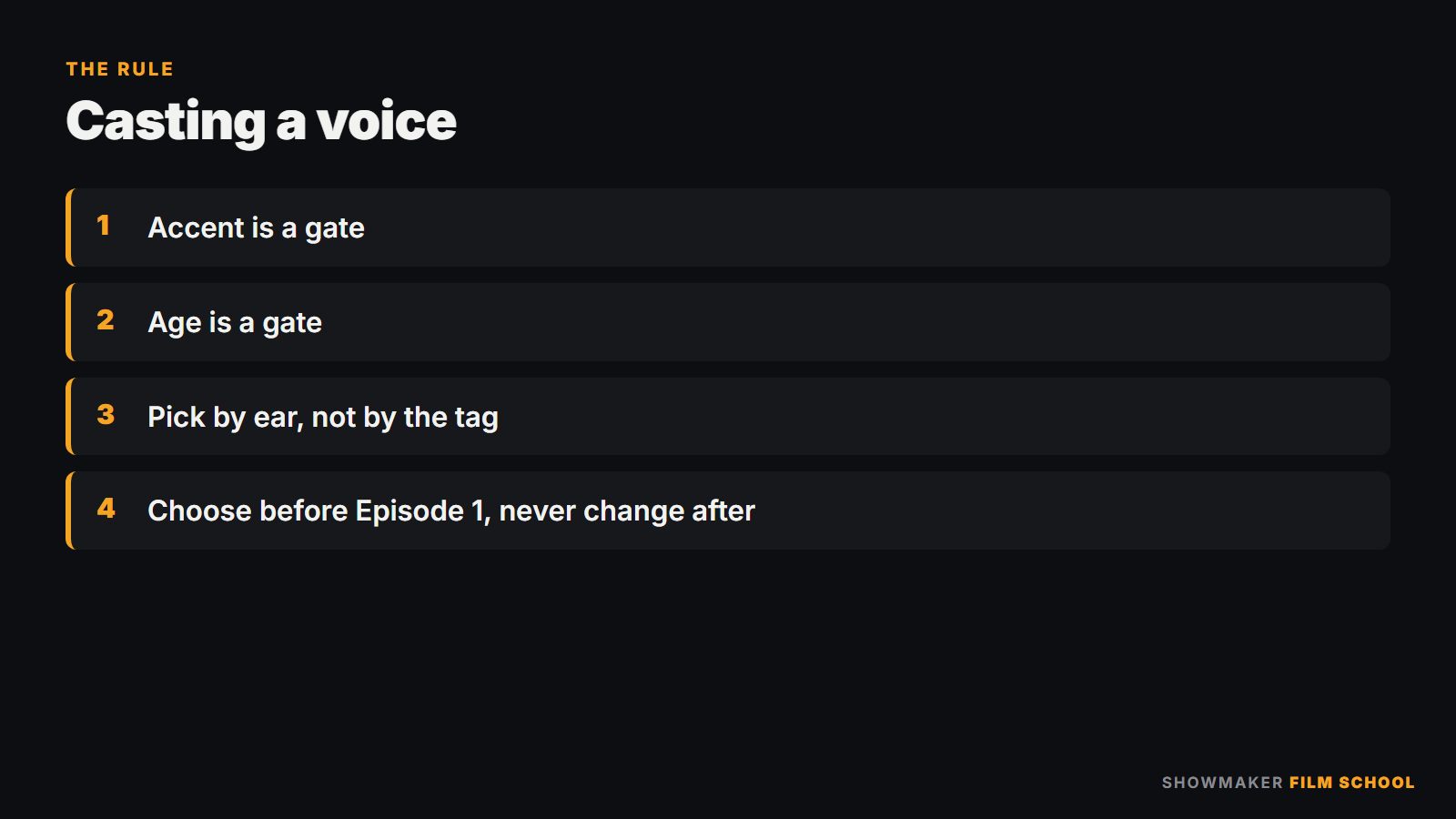
Treat accent and age as gates. A voice either passes them or it is out, however nice it sounds. On our show the Mom Test, the first automatic casting gave a Black family from Chicago an edgy young voice, a professional English man, a Spanish voice and a robot voice. The director stopped everything and recast every member of the family with African American voices before a single line was voiced. A Nigerian character needs a Nigerian voice, and a Mexican family needs Mexican Spanish.
A voice passes the gates or it is out. Then you choose by ear.
Voice lists describe their voices with tags, and the tags are sometimes wrong about the accent. Listen. Have each candidate read the same line from your script, one your character would really say, and pick by ear. Then listen to two characters back to back. Siblings can sound related; a married couple should sound different enough that a viewer looking away still knows who is talking.
Children are a special case. Many voice libraries are made only from adult voices. When you need a child, design a voice from a description: the age, where they grew up, how they speak. For example, "a seven-year-old boy from the South Side of Chicago, quick and cheeky, a little hoarse". Listen to several results and keep the one that sounds like a real child, not an adult pretending.
Choose voices before Episode 1 is rendered, and never change them after. Our Guadalajara telenovela's first episode was rendered with no voice takes, so the video model invented every character's voice. Those voices were stored nowhere, and from Episode 2 on the family sounded different. A series needs one voice per character, chosen by you, from the first line to the last.
Next in the app: the steps in ShowMaker, the exercise and a 3-question quiz.
Turn each scene into panels that open on one wide and then frame one person or object at a time.
A panel is one continuous take broken into beats: a few seconds of this, then a cut to that. Planning panels is the same job a director does with a shot list. With AI video it matters even more, because every shot is drawn fresh, and anything the model has to draw twice can come out different.
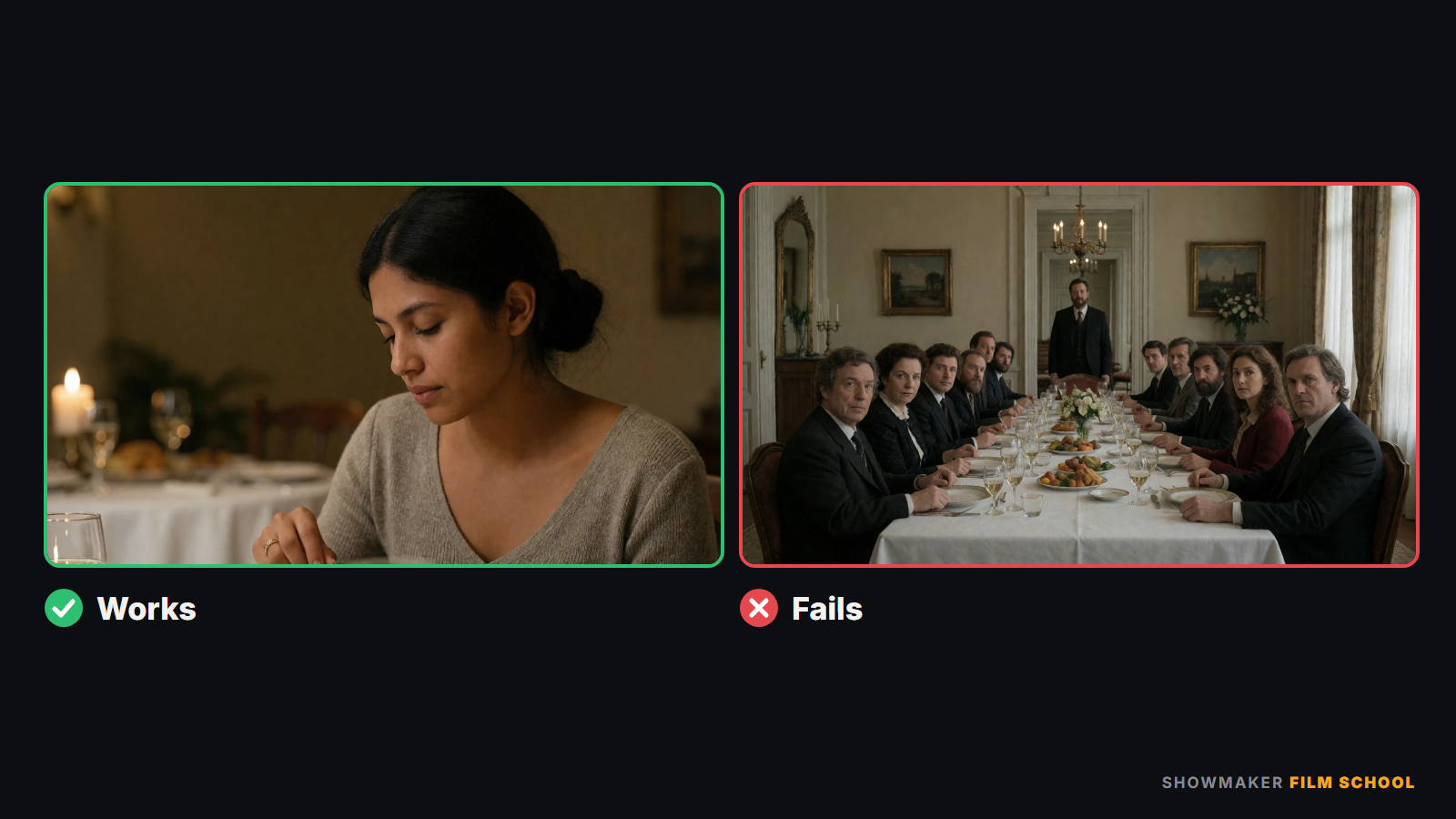
Open each scene with one wide shot that shows the room and where everyone is. That is the establishing shot, and it is the only shot that needs to show the whole geography. After it, frame one subject at a time: a close-up of Sofia, a close-up of the husband, an extreme close-up of the ring on the table. For the conversation, use over-the-shoulder pairs, where one person is only a shoulder at the edge of the frame and the other is the face we read.
A close shot of one person cannot contradict the room. A wide redrawn again and again invents people.
Why so strict? A close-up with one person in it carries no room layout. It cannot put the window on the wrong side or move someone to a different chair, so it can never contradict another shot. You can even reuse it later. In one episode of our Guadalajara telenovela, every seating mistake we found was in a wide: a second grandmother at the table, a stranger in an empty seat, a daughter who vanished from her chair. The close-ups were clean.
So limit wides. Use a new wide only when someone enters, leaves or crosses the room, and when you do, name every person in it and say who is not there: "No one else is in the room; the other chairs are empty." A group word like "everyone" or "the guests" invites the model to invent people.
Write each beat as an action the camera can see. Emotion is an action too: her eyes drop, his jaw sets, she turns away, a tear falls. Do not write held stares or long silent pauses. The models do not perform a held look on cue, and you get dead air or drift. Keep scenes to two people talking where you can; three faces in one dialogue frame tend to blend.
Every person in a beat is named by their tag, and the room is named in the first beat. The speaker's tag goes right before their line, like: @sofia leans in and says: "Not tonight."
Next in the app: the steps in ShowMaker, the exercise and a 3-question quiz.
Start frames, re-shoots and fixing a bad take in its panel
Draw and check the first frame of each shot before you pay to render, and fix bad takes the cheapest way first.
The start frame is the first picture of a shot. The video model animates from it, so if the start frame is wrong, the whole shot is wrong and you have paid for it. Checking a still costs seconds. Checking a render costs credits. So draw the start frames first and look at every one.
Check four things in each frame. The face: is it the right person, the right age, the right skin shade? The outfit: is it the one for this story day? The room: is it the right room with the key feature in place? The geography: is each person on the correct side of the table, door or screen?
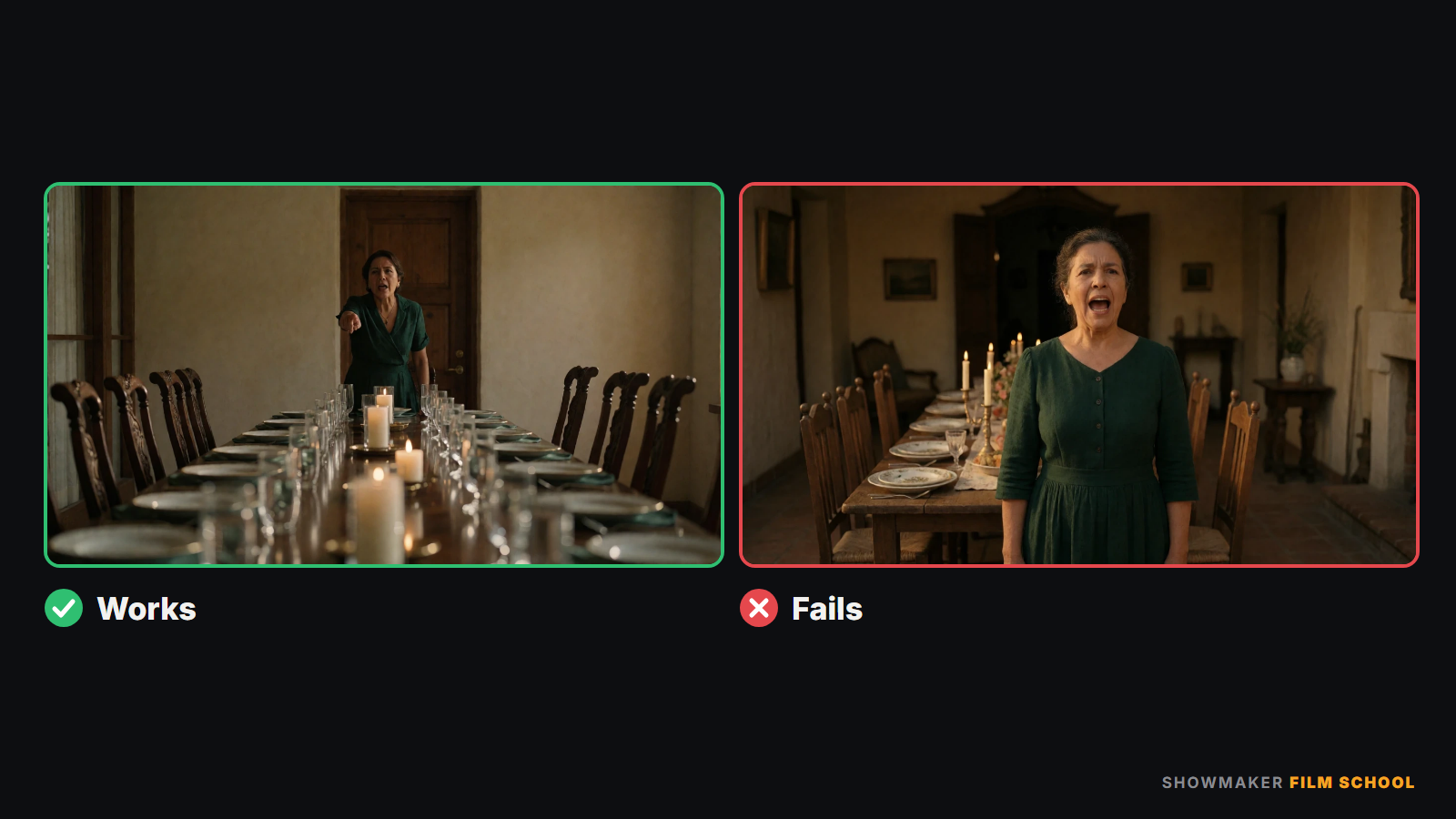
A single at the end of a table looks back down it. With the table behind her, she seems to face away from the person she is shouting at.
Geography is where AI pictures fail most quietly. In a Guadalajara episode a woman stood at the foot of a long table shouting at the matriarch at the head. The model drew the table behind her, which made her look like she was facing away from the person she was shouting at. A single at the end of a table looks back down the table: the tabletop fills the foreground between the camera and her. Screens are the same. When people stand behind a monitor watching it, the camera in front of them sees the back of the monitor. Show what is on the screen in a separate shot from behind them. The model likes to turn screens toward the camera, so write it down.
When a rendered take has a defect, fix it in this order. First ask whether the cut can hide it. In another Guadalajara episode a wide showed one daughter missing from her chair during a slap. The fix cost nothing: cut to a close-up of the woman being slapped, then the man catching the hand, then close-ups of the argument, and only show the daughter afterward. Second, fix the picture: change one thing in the start frame, or re-shoot from a different angle. Third, re-render only the panel that needs it.
Make every fix inside the project's panels, never in a separate editing program. A fix in the panel can be seen, checked and redone by you or anyone you work with. A fix made outside is lost the next time the episode is built.
Next in the app: the steps in ShowMaker, the exercise and a 3-question quiz.
Dialogue scenes, phone calls and voices off screen
Voice every line before rendering, and stage phone calls so the wrong face never speaks the caller's words.
Voice before picture. Record every line before you render, then let each take set the timing of its beat: the take's length plus about half a second. When the timing comes from the guess of whoever planned the shot, you get speeches cut off or long dead gaps. When it comes from the take, the scene breathes like people talking.
Stage most dialogue as over-the-shoulder pairs: we see the face of the person speaking or listening, and the other person is a shoulder at the edge of the frame. Two people per conversation frame is the ideal. Add a reaction close-up when a line lands, so the audience sees what it cost.
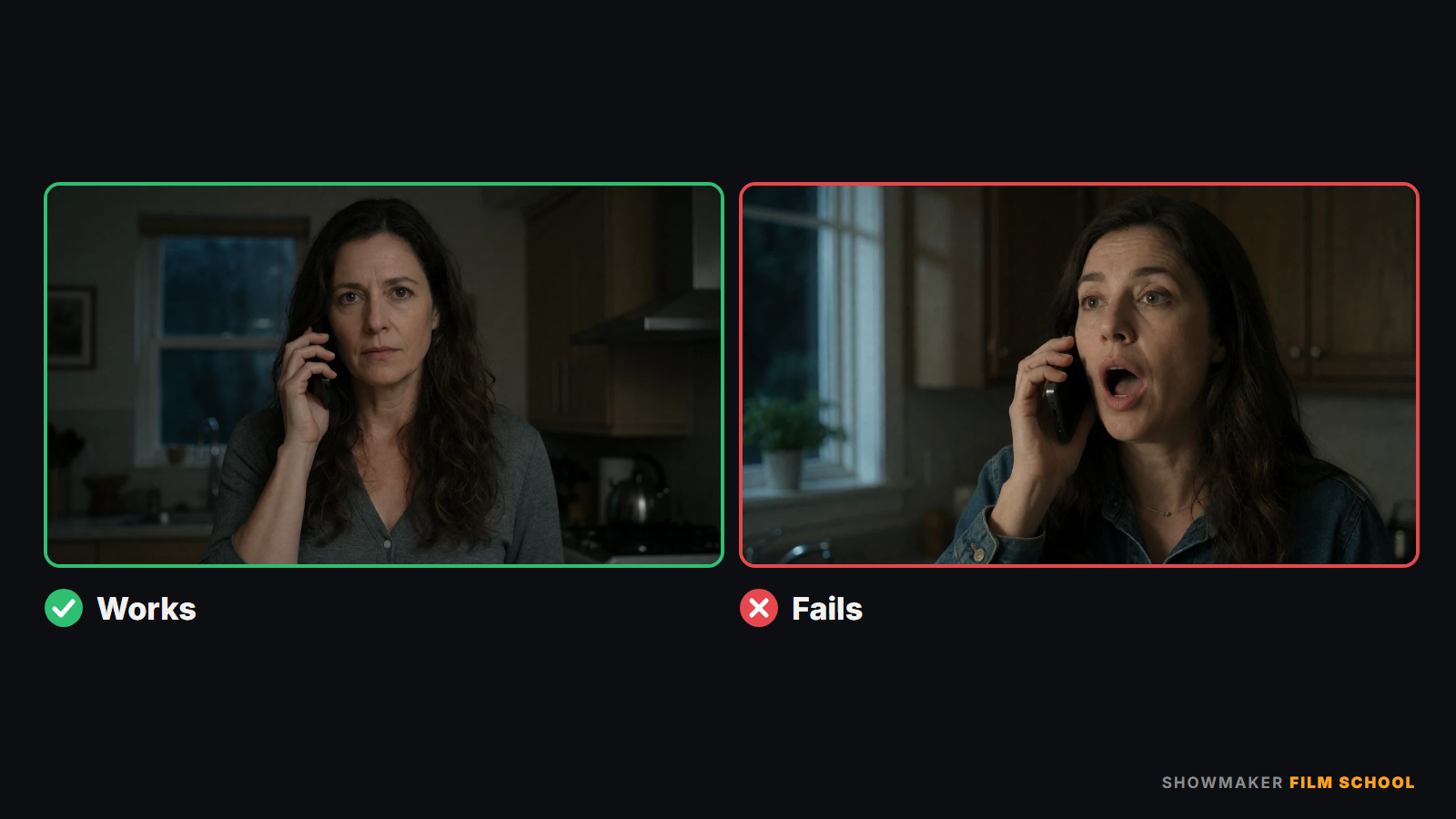
The listener's closed lips keep the caller's words where they belong. An open mouth on the listener makes her look like she is saying them.
Lines spoken by someone who is not on screen need care. When a line belongs to a person outside the frame, the video model tends to move the lips of whoever is in the frame. In our Guadalajara telenovela, a daughter mouthed her mother's lines from the next room, and the lawyer's lines on the phone too. It looks like a ventriloquist act.
There are three ways to stop it. Write the listener's mouth into the beat: "she does not speak; her lips stay pressed together." Frame something with no face: the door, the phone on the table, the back of the speaker's head. Or make the caller a voice-only character, a character who has a voice and no pictures, so nothing in the frame is told to say their line.
Phone calls in micro-drama are common, since a call brings bad news into a room. In our show Breaking Containment, the caller Diane is heard only through the phone. Her voice has a phone effect, so it sounds thin and far away, and we stay on the face of the woman listening to her. That face is the drama: the news lands on her.
Keep the delivery notes light. A plain line, well cast, usually sounds better than one loaded with acting directions. Add a feeling tag only where the scene turns on how it is said, such as a whisper or a shout, and listen to that take next to the character's other lines to make sure it still sounds like the same person.
Next in the app: the steps in ShowMaker, the exercise and a 3-question quiz.
Cheap models for silent inserts, and when to pay for a better one
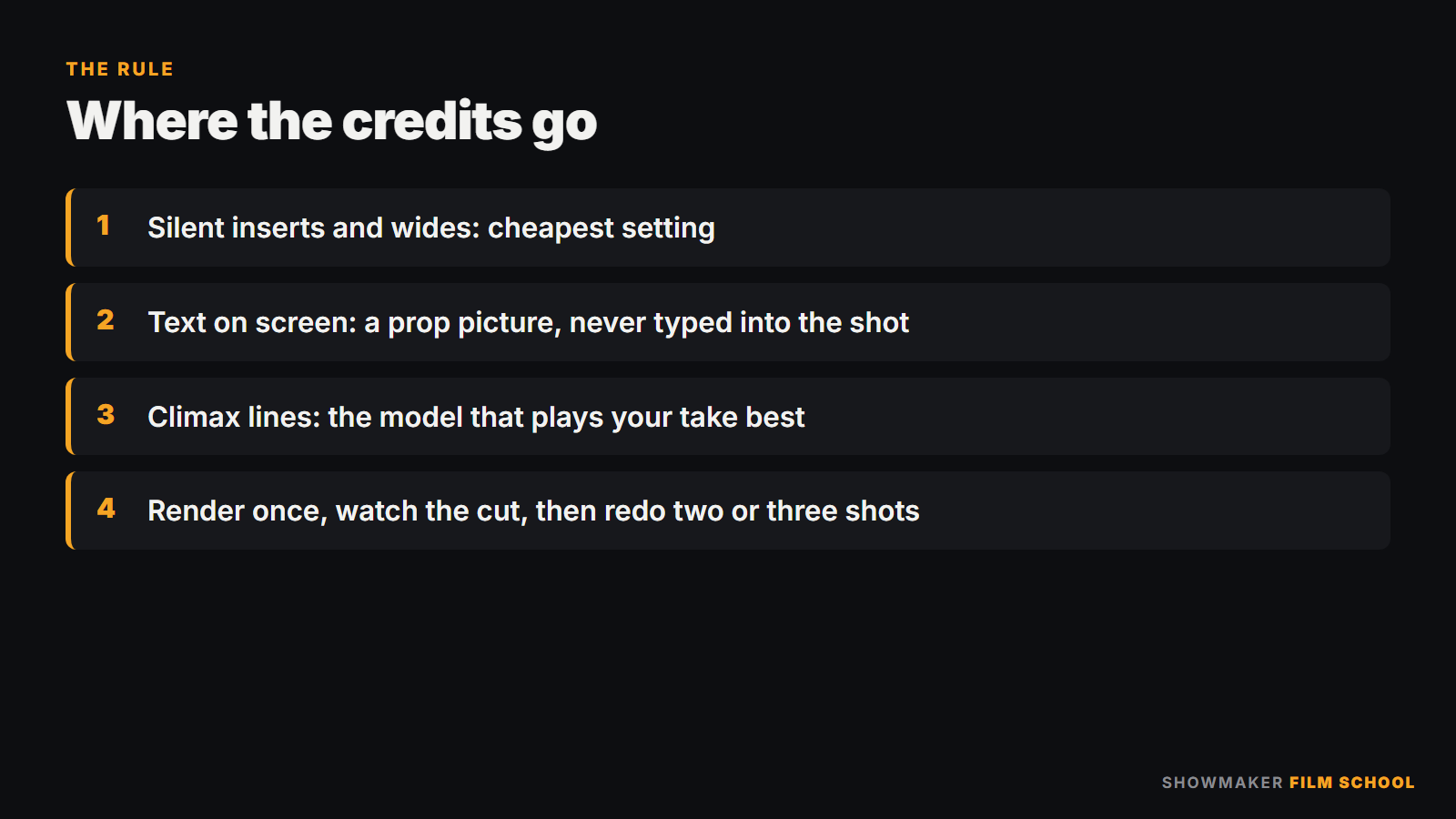
Render the whole episode once on modest settings, then spend more only on the few shots that carry the feeling.
Film crews have always spent unevenly. The big emotional close-up gets the best lens and the extra takes; the shot of a hand turning a doorknob gets five minutes. Spend the same way. Most of an episode does not need the most expensive model, and some of it does not need acting at all.
Silent inserts are the easy money. A ring on a tablecloth, a key turning, a phone face down on the counter, a door handle moving. Nobody speaks, nobody needs to act, and the shot is short. A cheaper model at a lower quality setting draws these well. The same goes for establishing wides with no dialogue.
Spend where the feeling is. Draft everything once, then pay for the few shots that carry the episode.
Speaking close-ups are where models differ. Some follow your voice take closely and move the lips in time; others re-perform the line and stutter. Your climax line, the slap, the reveal, the confession, deserves the model that plays your take best. One or two of those shots per episode is usually enough.
Work in one pass. Render every panel once on your everyday setting, build the cut, and watch the whole episode. Only then decide which two or three shots to redo, or to move to a stronger model. Redoing shots before you have seen the episode as a whole wastes credits on shots the cut may never use.
Anything with words on it, like a text message, a letter, a sign or a newspaper, should be a prop picture with the exact words drawn in it, and the shot should use that picture. A video model asked to write words from a description invents letters. One of our renders spelled a notice as "ULTIMO AVSIO".
To give you a sense of scale: one of our own episodes, 1 minute 48 seconds long, used 818 credits from start to finish, including pictures, voices, renders and re-renders. A Starter plan has 900 credits a month. Plan your first episode at 60 to 90 seconds, and draft cheaply.
Next in the app: the steps in ShowMaker, the exercise and a 3-question quiz.
Vertical cuts, captions in the scene's language, and music
Finish your episode for the phone: a native vertical frame, captions in the spoken language, and music that sits under the voices.
Micro-drama is watched on a phone held upright, often with the sound off at first. Three things decide whether it feels made for that screen: the frame, the captions and the sound.
The frame should be vertical from the start. Cropping a wide 16:9 shot to 9:16 throws away most of the picture and often cuts a face in half. If your episode was shot wide, make a vertical version and render its shots composed for a tall frame. Keep faces and the key action in the center and a little high. The feed puts its own buttons, captions and channel name over the bottom third and the right edge. A close-up works even better tall than wide, so the one-subject shots you planned in Module 3 are already the right shape.
In a vertical frame, faces sit centered and a little high. Low in the frame, they end up under the app's buttons.
Captions are the line, in the language it is spoken. A Spanish telenovela gets Spanish captions. Our Guadalajara audience is mostly Spanish-speaking, and their captions read the words the characters say. If you want to reach a second audience, add a second line in their language under the first, never instead of it. Keep captions short, high enough to clear the feed's buttons, and in the same place in every shot.
Music is chosen by tone, scene by scene. A scene is tense, or tender, or triumphant, and its music says so. Do not run music wall to wall. Scenes with no music make the scored ones hit harder, and in our own episodes nearly half of a scene can run dry. Under dialogue, music drops low, so the voice is always on top. A viewer will forgive quiet music; they will not forgive a line they could not hear.
End on the cliffhanger with no frozen tail. A held last frame or a long end card after the question gives the viewer time to swipe away before they feel it. Cut on the question, then a short fade.
Next in the app: the steps in ShowMaker, the exercise and a 3-question quiz.
A hook Short that sends viewers to the full episode
Cut a short trailer from your best moment that ends on a question and asks for the follow.
A Short is a trailer. Its only job is to make a stranger want the full episode, and to make them follow you so you can reach them again. Treat it as marketing for the film, not as a second film.
Pick the moment with the strongest question. Usually it is the humiliation or the reveal: the papers sliding across the table, the line "He is not your father." Start on it or a breath before it. Do not explain who anyone is. End before the answer, on a face or a line that leaves the question open, and point to where the answer is.
Start on the strongest moment and stop before the answer. The door opens, and we cut before we see who is there.
Every Short asks for the follow, out loud. A view is a one-off. A subscriber is someone you can reach with Episode 2. End with a short subscribe card that fades in over the last shot, with no frozen tail, and make the first line of the description ask for the subscribe and link the full episode.
Make more than one. You learn what the feed rewards only by posting different ideas and watching what happens. Cut three Shorts from the same episode: one on the humiliation, one on the secret, one on the funniest or cruelest line. They will not do equally well, and the difference teaches you more than any rule. Post them on different days.
Our La Abuela film did exactly this. We posted a hook Short from its opening and linked the full film from the Short, so viewers who wanted the rest of the story had one tap to get there.
Keep each Short between 15 and 45 seconds. Shorter is fine if the question lands. A Short that tries to tell the whole episode answers its own question and gives nobody a reason to click. Watch your Short once with the sound off: if the question still reads from the faces and the captions, it is ready.
Next in the app: the steps in ShowMaker, the exercise and a 3-question quiz.
YouTube: titles, thumbnails and descriptions that link the full film
Package each episode so the title, picture and description all sell the same hook and lead to the next video.
On YouTube, a viewer sees your title and thumbnail before they see a single frame of your film. The packaging is the first scene. It should sell the same hook the episode opens with, so the viewer who clicks gets exactly what they were promised in the first ten seconds.
The title is the hook in words. Use the pattern: what was done to her, and the secret. "They fired the maid at the party... not knowing she owned the house." It names a humiliation and promises a reversal. Write it in the language of the show and its audience. A Spanish telenovela gets a Spanish title. Keep one show, one language, one channel, so the people the channel already has are the people the next episode is for.
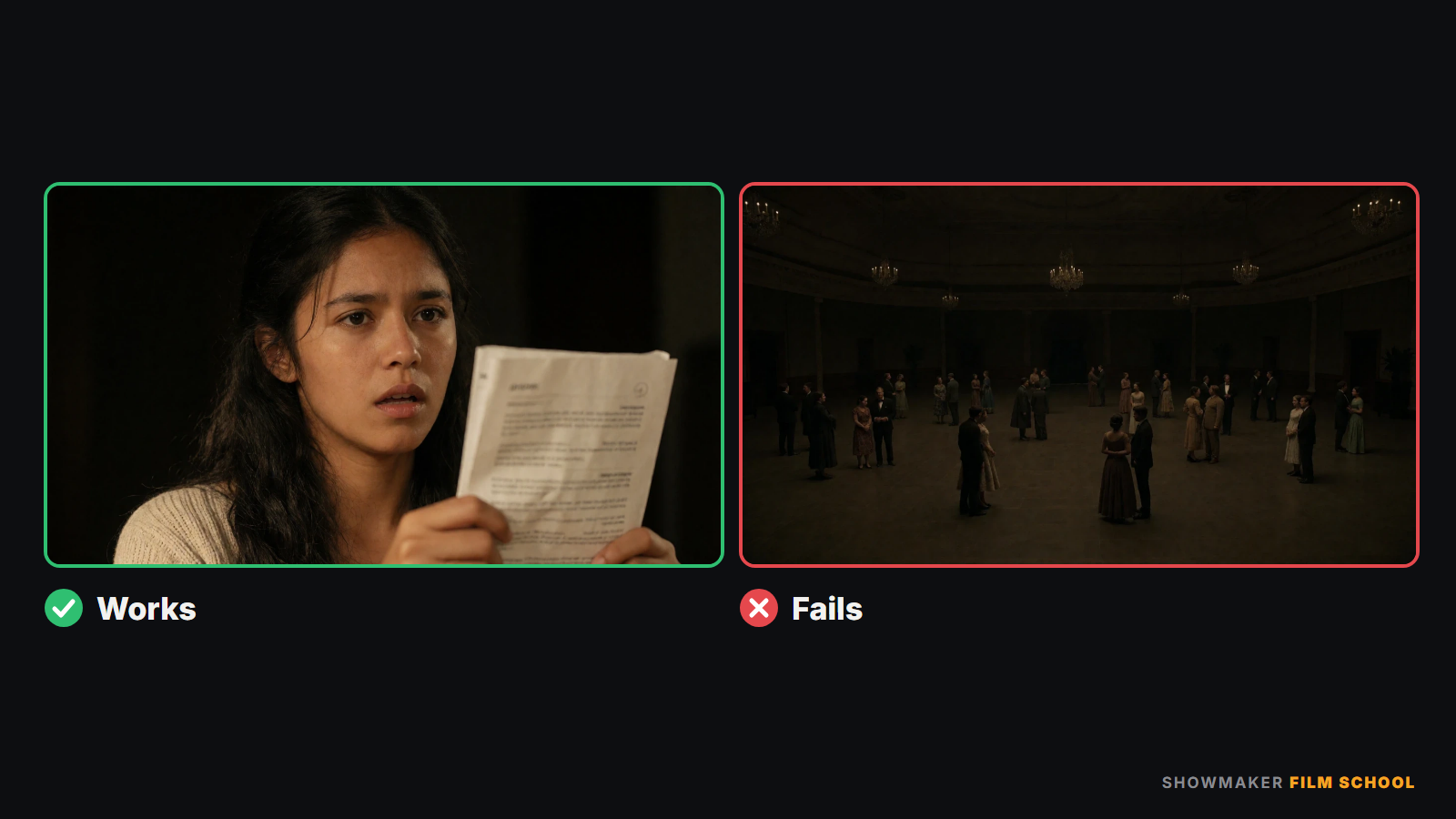
A thumbnail is read at the size of a stamp. One face and one feeling read; a dark crowd does not.
The thumbnail is one face, one feeling and one object from the story. A woman's shocked face lit hard, holding the papers. Big, close and clear enough to read at the size of a stamp. A dark wide shot with six small people in it reads as nothing on a phone. Choose your strongest start frame or a frame from the render where the emotion is at its peak. Make sure the face is the right face; a thumbnail with a different-looking lead is a broken promise.
The description does two jobs. Its first line asks the viewer to subscribe, because many viewers only read one line. Its next lines link the full episode, the next episode, and the series playlist, so a viewer who liked it has somewhere to go. Then a short summary of the episode that does not give away the cliffhanger.
Upload as unlisted first. Watch the video on YouTube itself, on a phone, with the sound off and then on. Check the captions, the first second, the end card and the links. Only then make it public.
Link in both directions. The Short links the episode, and the episode's description links the next episode. A series that is easy to follow from one video to the next is a series people binge.
Next in the app: the steps in ShowMaker, the exercise and a 3-question quiz.
Reading the numbers: completion, drop-off and follows
Read the few numbers that tell you whether an episode works, and use them to fix the next one.
Once your episode is out, the audience starts talking to you through numbers. Most of them are noise. A few tell you exactly which shot to fix.
Start with the trap. On YouTube Shorts, every replay counts as a view. Our Guadalajara Episode 1 Short showed about 119,000 views on its first processed day, but only about 11,000 unique viewers, because people watched it over and over. That looping is good news, but it means a follow rate worked out on views looks tiny. Work it out on unique viewers. And in public, say views, never people.
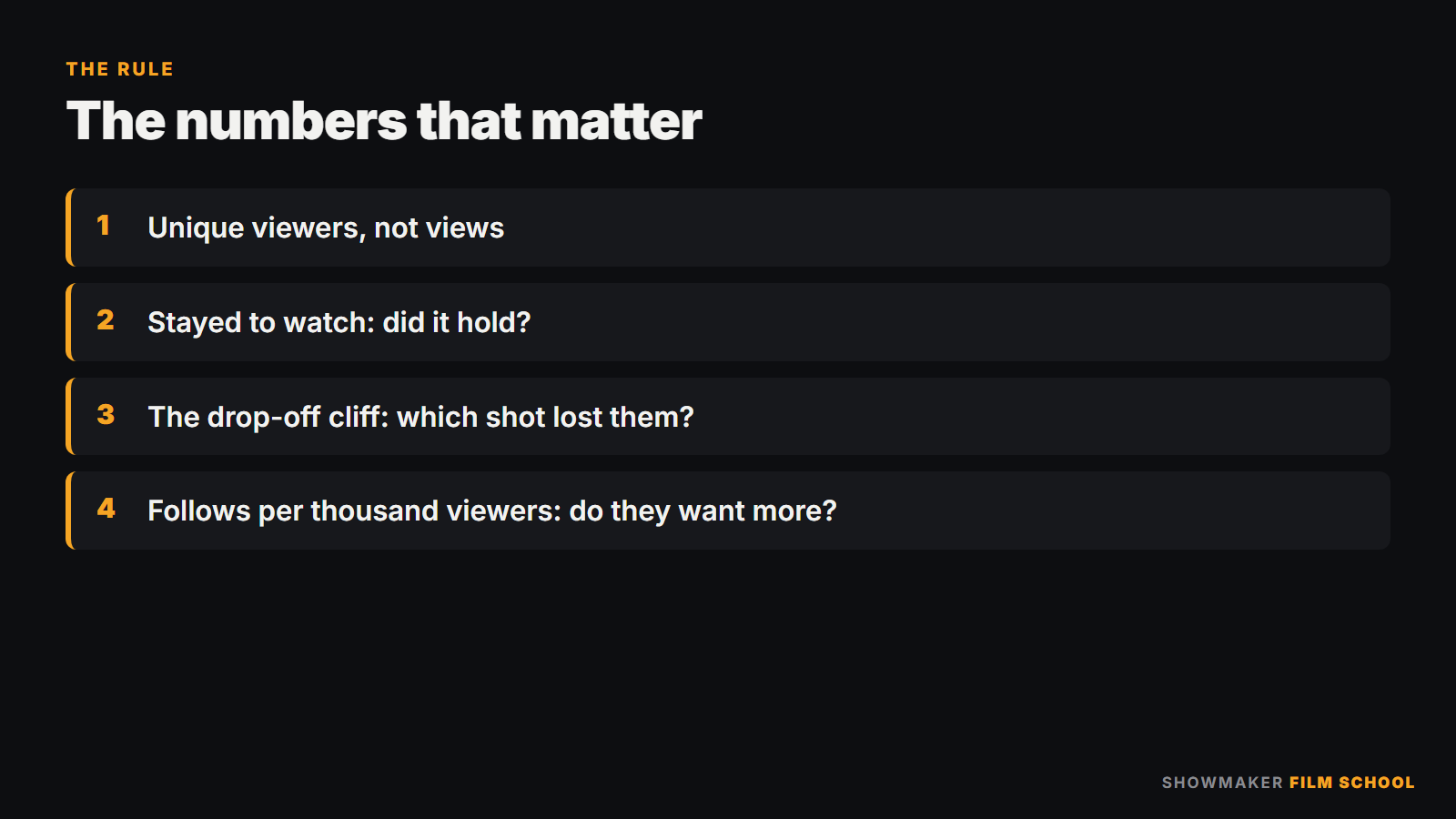
Three numbers tell you most of what you need. Work them out on unique viewers, never on views.
Completion tells you whether the episode held. YouTube calls it stayed to watch for Shorts, and average percentage viewed for longer videos. If most people who start your episode finish it, the story works. If they leave early, find out where.
Drop-off tells you where. The retention graph is a line that falls over the length of the video. A gentle slope is normal. A cliff is a shot that lost people: a slow wide, a confusing cut, a line nobody could hear, a face that changed. Note the second where the cliff starts, open that moment in your panels, and watch it. That is the shot to fix in this episode, or the mistake not to repeat in the next.
Follows tell you whether the viewer wants more. Subscribers gained per thousand unique viewers is the number that grows a series. A Short can hold its audience and still bring few follows if it never asks.
Reach and holding are different. One of our Shorts kept 69 percent of its viewers to the end and reached only 322 views. The story worked; the feed did not push it. That is why you post many ideas: holding power you can fix in the panels, but reach you mostly learn by trying.
Change one thing at a time. If Episode 2 has a new title style, a faster opening and a different thumbnail, you will not know which one moved the numbers.
Next in the app: the steps in ShowMaker, the exercise and a 3-question quiz.